
Disposable filling hose |
P00.00-4715-01

1 | Part number |
2 | Quantity of AdBlue® refills |
4 | 1.89 l refill bottle |
P14.40-2562-11
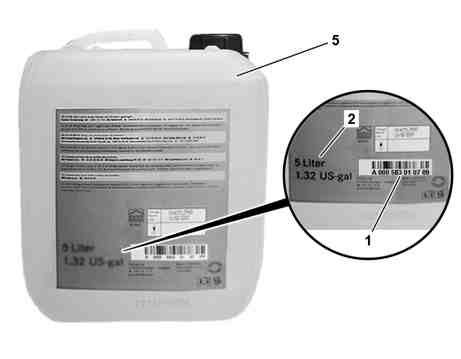
1 | Part number |
2 | Quantity of AdBlue® refill canisters |
5 | 5 l refill canister |
P14.40-2563-11

1 | Part number |
2 | Quantity of AdBlue® refill canisters |
6 | 10 l refill canister |
P14.40-2564-11
Do not use the refilling fitting supplied with the AdBlue® 10 l refill canister (6) or the 20 l AdBlue® refill canister for filling.
Otherwise there is a risk of contaminating the working area and the environment.
The following filling options are now available with immediate effect:
1.89 l refill bottle (4)
The 1.89 l refill bottles (4) are not intended for refilling in the workshop but are to be used only as a refilling option for the customer.
For filling with the AdBlue® refill bottle, see corresponding chapter in the operator's manual of the desired model series.
5 l refill canister (5), 10 l refill canister (6) or 20 l refill canister
Alternatively, the 5 l refill canister (5), the 10 l refill canister (6) as well as the 20 l refill canister can be used for filling using the disposable filling hose (A 000 583 22 04).
The disposable filling hose A 000 583 22 04 is designed for one-time use only and may not be reused.
Otherwise, soiling can reach the emission control system and thereby cause damage or malfunctions.
Cover working area around the AdBlue® filler neck with film and absorbent paper.
Dirt must not be allowed to find its way into the emission control system.
Damage or malfunctions can occur otherwise. Due to the risk of soiling and because the quantity is not calibrated, it is also not permitted to transfer from large containers into AdBlue® refill canisters.
Do not allow any paper to find its way into the AdBlue® filler neck and AdBlue® tank.
There is a risk of damage to the AdBlue® system otherwise.
Disposable filling hose:
This hose has a locking mechanism which enables drip-free filling to be performed. The fixed connection between the refill canister and the AdBlue® tank prevents any overfilling. The 5 l refill canister (5) has the same locking thread as the 10 l refill canister (6) and the 20 l refill canister. This ensures that the disposable filling hose fits on all three refill canisters.
1 Screw one-way filling hose onto AdBlue® refill can.
The one-way hose remains closed until it is fastened to the vehicle's AdBlue® filler neck.
2 Fit disposable filling hose onto the AdBlue® filler neck on the vehicle.
3 Screw on finger-tight in clockwise direction.
Do not tighten the disposable filling hose too much. Once a resistance is felt, the disposable filling hose is sufficiently tightened.
4 Lift refill canister and place on its side. It may be necessary to move the refill canister in this position to enable the filling process to take place. If the refill canister does not continue to empty, the AdBlue® tank is full.
5 After filling has been completed, carefully unscrew the one-way filling hose from the AdBlue® container first and then slowly detach it to ensure that the AdBlue® still in the bleed line can be drained off.
This helps to prevent any soiling.
The most varied types of AdBlue® containers are available on the market. The disposable filling hose, however, is specially matched to our refill canister. A reliable and drip-free filling process can only be guaranteed when this particular combination is chosen.
For filling with the AdBlue® refill canister, see corresponding chapter in the operator's manual of the desired model series.
Pump nozzle of an AdBlue® pump (e.g.. at a gas station)
For filling with the pump nozzle of an AdBlue® pump, see corresponding chapter in the operator's manual of the desired model series.
Action in case of "Refill AdBlue" service indicator before the maintenance interval is reached
If the service display "Refill AdBlue" is shown on the multifunction display before reaching the maintenance interval, the missing AdBlue® can be refilled with the 1.89 l refill bottle (4) as well as with the disposable filling hose and the 5 l refill canister (5).
This ensures that the "Refill AdBlue" service indicator disappears.
In order to avoid the risk of contamination, we recommend that the customer be shown how to refill the tank.
Do not overfill AdBlue® tank.
The AdBlue® tank can otherwise be damaged.
Cleanliness is absolutely essential when working on the AdBlue® system. This means that only lint-free cleaning cloths may be used to remove AdBlue® residue. This applies when removing AdBlue® residue on the AdBlue® filler neck and also when cleaning other equipment.
Refilling AdBlue® as well as testing and diagnostic operations on the AdBlue® system due to a low AdBlue® fill level in the AdBlue® tank must not be invoiced under warranty. For this purpose, the specified filling capacities of the respective AdBlue® tank must also be observed.
See corresponding chapter in operator's manual for the desired model series for the maximum AdBlue® filling capacity. The maximum AdBlue® filling capacity can vary depending on the special equipment of the vehicle.
The maximum filling capacity must not be exceeded.
Otherwise components of the AdBlue® system can become damaged.
For recognition of the fill level on all model series, as of the introduction of model 906 with SCR exhaust aftertreatment system (selective catalytic reduction) generation II, the fill level sensor (ultrasonic sensor) requires an air cavity. Overfilling can result, among other things, in the AdBlue® filling process not being recognized and the warnings on the display of the instrument cluster continuing to be displayed.
When filling the AdBlue® tank, it is essential to ensure that only pure AdBlue® is poured in.
Otherwise, the AdBlue® system can become damaged.
The component parts of the AdBlue® system (e.g. delivery/extraction pump, tank module, hoses, lines or sealing rings) are not resistant to fuel, coolant, brake fluid or mineral oil residues. In order to prevent repeated failure, the following components must therefore be replaced in vehicles in which the AdBlue® tank has been incorrectly filled:
AdBlue® tank
All AdBlue® hoses, lines and sealing rings
AdBlue® delivery/extraction pump
AdBlue® tank module
Please note that repairs as a result of filling the AdBlue® tank with the incorrect fluid are not included in the scope of warranty.
We advise against cleaning the components, as residues from the cleaning agents could damage the injection valve, the tank module and the delivery/extraction pump.
Parts ordering note |
Part no. | Designation | Quantity |
A 000 583 01 07 12 | 1.89 l AdBlue® refill bottle | n. B. |
A 000 583 01 07 09 | 5 l AdBlue® refill canister | n. B. |
A 004 989 04 20 12 | 10 l AdBlue® refill canister | n. B. |
A 004 989 04 20 15 | 20 l AdBlue® refill canister | n. B. |
A 000 583 22 04 | Disposable filling hose | n. B. |
Picture no., etc. | Work notes | ||
Warning | Risk of burn injuries and scalding when working on AdBlue(R) lines and the component parts attached to them. Risk of injury to skin and eyes when handling AdBlue(R). Risk of poisoning caused by swallowing AdBlue(R) | Pour AdBlue® only into suitable containers. Wait until the pressure is released before starting any work on the exhaust aftertreatment system. | |
Topical note | Notes on use, material properties and handling of NOx reducing agent | ||
Referenced documents
- ah4920n000201a Notes on use, material properties and handling of NOx reducing agent
- as4920z000201a Risk of burn injuries and scalding when working on AdBlue(R) lines and the component parts attached to them. Risk of injury to skin and eyes when handling AdBlue(R). Risk of poisoning caused by swallowing AdBlue(R)