GF46.35-P-2000AK | Electrical power steering (ES) limp-home mode, function | 15.4.04 |
MODEL 169.0 /3, 245.2 up to Model Year 8
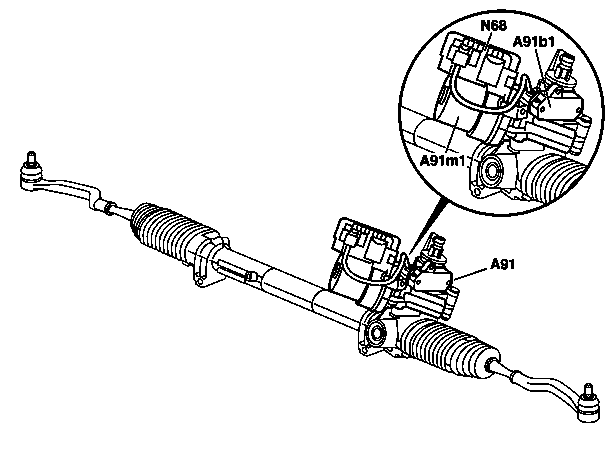
P46.35-2007-06
A91 Electromechanical control unit (ES)
A91b1 Electrical power steering (ES) torque sensor
A91m1 Electrical power steering (ES) actuator motor
N68 Electrical power steering (ES) control unit
With electrical power steering (ES) the system safety must be guaranteed by permanent fault monitoring which rules out a malfunction even in the event of failure of individual electronic components. The safety requirement on the electrical power steering is that an electronic fault may not lead to a loss of steerability. The vehicle must remain steerable when the ES is inactive.
With "circuit 15 ON" the electrical power steering (ES) control unit (N68) carries out a self-test. Power steering assistance is not activated in the case of a deviation from the stored specified values.
-----------------------------------------------------------------------------------------
When in driving mode the signals from the electrical power steering (ES) torque sensor (A91b1), the motor position sensor in the electromechanical control unit (ES) (A91) and the current measurement in the electrical power steering (ES) control unit (N68) are continuously checked for plausibility. The signals must be within the stored, permissible tolerance values If the values are outside the tolerance values, the ES is switched off immediately by the electrical power steering (ES) control unit (N68). The power steering assistance is slowly reduced in the event of a loss of the "circuit 15 ON" signal.
A slow transition to purely manual steering is significantly easier for the driver to control.
-----------------------------------------------------------------------------------------
If the ES is inactive, first the torsion angle and then the torque of the torsion bar within the steering mechanism must be overcome by the driver. A mechanical connection is produced between the steering input shaft and the drive pinion. The vehicle is steerable but with a considerably higher expenditure of force.
Fault display
If a fault is detected by the electrical power steering (ES) control unit (N68) this is conveyed to the driver via the warning message "Power steering defect! Visit workshop!" in the multifunction display (A1p13).
The instrument cluster (A1) receives the warning message from the electrical power steering (ES) control unit (N68) via the Controller Area Network bus class C (engine compartment)
CAN-C. In the event of a failure of the power steering assistance the warning message should draw the driver's attention to the change in vehicle steering characteristics or to the cause for the change in steering characteristics.
Rack-and-pinion steering gear, location / task / design / function | |||
Electrical power steering (ES) torque sensor, location/task/design | |||
Motor position sensor, electrical power steering (ES), location/task | |||
Electrical power steering (ES) actuator motor, location/task | |||
Electrical power steering (ES) control unit, location/task |
Referenced documents
- gf4620p1000ak Rack-and-pinion steering gear, location / task / design / function
- gf4635p5000ak Electrical power steering (ES) torque sensor, location/task/design
- gf4635p6000ak Motor position sensor, electrical power steering (ES), location/task
- gf4635p6500ak Electrical power steering (ES) actuator motor, location/task
- gf4635p7000ak Electrical power steering (ES) control unit, location/task