Engine | 608 in model 118, 177, 247 |
with code 460 (Canada version) | |
with code 494 (US version) | |
Engine | 654 in model 118, 177, 247 |
with code 460 (Canada version) | |
with code 494 (US version) | |
Engine | 654 in model 213, 238, 257 |
as of model year 2021 | |
with code 460 (Canada version) | |
with code 494 (US version) | |
Engine | 656 in model 167, 223 |
with code 460 (Canada version) | |
with code 494 (US version) | |
Engine | 656 in model 213, 238, 257 |
as of model year 2021 | |
with code 460 (Canada version) | |
with code 494 (US version) |
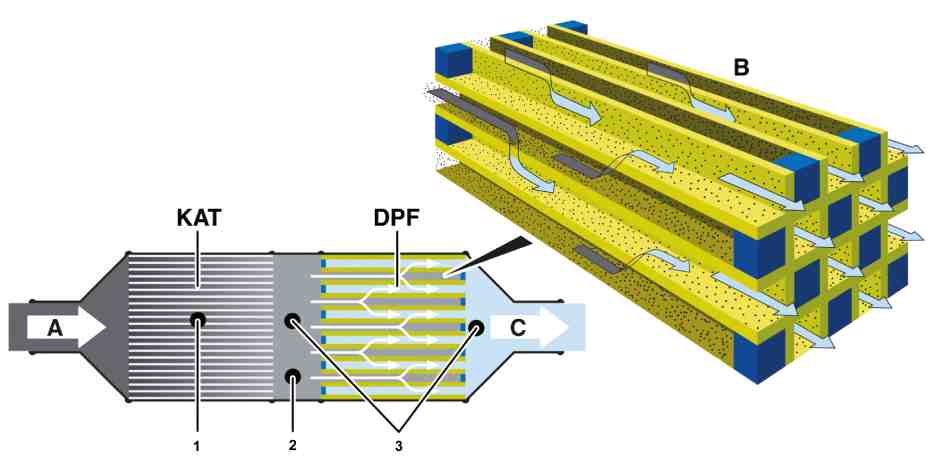
P14.40-2662-79
Schematic diagram of how the soot particulate filter (diesel) operates |
1 | Temperature sensor upstream of the CAT | KAT | Oxidation catalytic converter | |
2 | Temperature sensor downstream of TWC | A | Exhaust gases from engine | |
3 | Differential pressure sensor | B | Filtering of soot particles | |
DPF | Soot particulate filter | C | Exhaust gases downstream of soot particulate filter |
Overview
This document contains information on:
General
Function
General
The soot particulate filter follows on from the oxidation catalytic converter in diesel engines and, in spark-ignition engines, from the three-way catalytic converter. It filters out soot particles that are hazardous to the environment and to health from the precleaned exhaust gas. The stored particles burn during the regeneration phase.
Function
Soot particulate filter
The soot particulate filter has the function of filtering soot particles in the exhaust gas. 80 to 99.5% of them consist of pure carbon (C).
The soot particulate filter consists of a ceramic honeycomb filter body. It is composed of a multitude of ducts lying parallel to each other, which are sealed alternately. When the exhaust gases flow through the porous ceramic walls of the soot particulate filter, the soot particles settle on the surface. The filtered exhaust gas flows further through the ducts in the exhaust system that are open toward the rear.
In spark-ignition engines, the soot particulate filter is made of a particularly heat-resistant Cordierite. In diesel engines, it is made of silicon carbide.
Regeneration
To maintain the function of the soot particulate filter, regeneration takes place. The combustion engine control unit determines the soot content via the differential pressure sensor and starts the regeneration phase if a characteristics-map-based value is exceeded. Depending on the soot emissions and filter size, regeneration takes place after approx. 500 km.
During regeneration, the soot particles burn predominantly into carbon dioxide (CO2). Starting at a temperature of approx. 600 °C, the burn-off of soot particles accumulated in the soot particulate filter takes place via a regeneration process. For diesel engines in particular, such temperatures are rarely reached. An oxidation catalytic converter that is connected in series and a catalytic coating of the soot particulate filter ensure regeneration at lower temperatures.
In spark-ignition engines, regeneration takes place predominantly in overrun mode in conventional driving style. As soon as oxygen (O2) is available to the soot particulate filter, soot burn-off occurs. The highest temperatures of approx. 1,150 °C occur in the rear to center area of the soot particulate filter.
The regeneration process takes a few minutes and depends on:
Vehicle speed
Exhaust-gas temperature
Fuel level
Engine speed
Because the required exhaust gas temperature for regeneration is not sufficient in the normal operating status, the exhaust gas temperature is increased by a targeted post injection. During an additional post injection, fuel is injected during the expansion in the power stroke. The fuel does not burn completely, and the exhaust gas temperature increases.