GF49.10-P-3003T | NOX catalytic converter, component description | 19.4.06 |
ENGINE 642.920 in MODEL 211.022 with CODE (494) USA version
ENGINE 642.920 in MODEL 211.024

P07.04-2539-06
120/2 NOX catalytic converter
Location
The NOX catalytic converter is located near-engine mounted downstream of the turbocharger.
Task
The NOX catalytic converters provide an option to reduce nitrogen oxides (NOX).

P49.10-0339-75
Body
Schematic illustration of the NOX catalytic converter
111/1 Stainless steel housing
111/3 ceramic monolith
120/2 NOX catalytic converter
120/3 Expanding mat
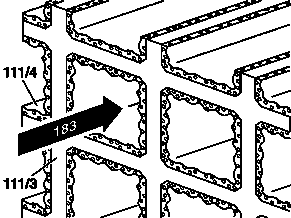
P14.40-2047-01
111/3 ceramic monolith
111/4 Intermediate layer (washcoat)
183 Exhaust
In addition to the rare metals platinum, palladium and rhodium, the NOX catalytic converter contains a basic NOX storage component, such as barium oxide, for example. To stabilize the barium oxide zirconium oxide may also be added, for example.
Thanks to the rare metal coating, the NOX catalytic converter also has the function of an oxidation catalytic converter.
Function
Storage mode
Normal operation of the engine is known as storage mode. During normal operation, the engine is driven with excess air. This is necessary as the combustion air ratio is restricted, mainly at high loads, due to black smoke in the form of soot particles. During normal operation, nitric oxide is oxidized together with the available oxygen (O2) into nitrogen dioxide (NO2), which is then stored in the storage component of the NOX catalytic converter as a nitrate (NO3). In addition to the NOX, residual sulfur from the fuel and engine oil is also stored in the NOX catalytic converter.
-----------------------------------------------------------------------------------------
Due to the storage of sulfates (SO4), the NOX catalytic converter loses its capacity to store NO3.
Regeneration of the NOX catalytic converter
Purging the NOX catalytic converter of nitrates (NO3) and sulfates (SO4) is carried out at speeds ranging between 1000 and 2700 rpm in the partial load range. Boundary conditions such as the intake air temperature, for example, restrict the operating range.
Purging the NOX catalytic converter of nitrates (NO3) takes place approx. every 2 to 5 minutes at a temperature inside the NOX catalytic converter ranging from 200 to 450 °C, provided that enabling of regeneration is not restricted by boundary conditions, for example operating range or temperatures.
Purging the NOX catalytic converter of sulfates (SO4) always takes place in combination with DPF regeneration, however, only approx. every 800 to 1600 km. If DPF regeneration is necessary at
a; lower kilometer interval, then purging the NOX catalytic converter of sulfates (SO4) does not necessarily take place.
-----------------------------------------------------------------------------------------
The O2-sensor downstream of TWC [KAT] (G3/1) measures the oxygen concentration in the exhaust and indicates that regeneration is complete by the sensor voltage change from lean to rich.
Purging the NOX catalytic converter of sulfates (SO4) takes place at temperatures within the NOX catalytic converter of
around 650 °C.
The temperature during regeneration of the NOX catalytic converter is monitored by the temperature sensor upstream of the turbocharger (B19/11) and by the TWC [KAT] temperature sensor (B19).
The interrupted regeneration is distributed over several driving cycles for short distances. Until the specified regeneration temperature is reached several heating-up phases are required. Regeneration occurs unnoticed by the customer.