GF07.04-P-6105MOR | Component description for a O2 sensor downstream of catalytic converter | 13.11.08 |
ENGINE 275.9 in MODEL 230.4 as of model year 2009
/ AEJ 08 model refinement package
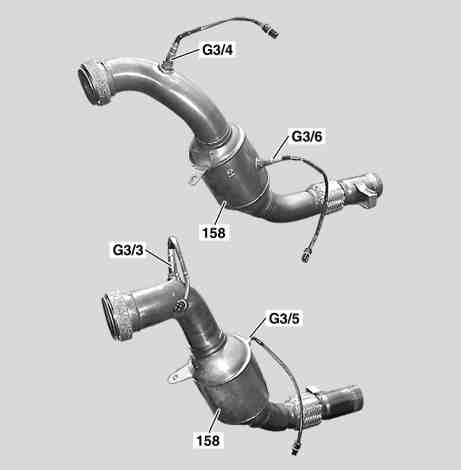
P14.00-2058-12
Front view of exhaust system
158 Firewall catalytic converter
G3/3 Left O2 sensor upstream of catalytic converter
G3/4 Right O2 sensor upstream of catalytic converter
G3/5 Left O2 sensor downstream of catalytic converter
G3/6 Right O2 sensor downstream of catalytic converter
Location
The O2 sensors downstream of catalytic converter are screwed in the side of the firewall catalytic converter. They project into the hollow spaces between both catalytic inserts for the firewall catalytic converters.
Task
The O2 sensors downstream of catalytic converter (guide and diagnostic sensors) detect the residual oxygen content in exhaust gas for the following tasks:
- Two-sensor control
- Monitoring of catalytic converter efficiency

Design
1 Sensor element (Nernst concentration cell)
2 Upper isolator bushing
3 Sealing package
4 Sensor housing
5 Lower isolator bushing
6 Outer protective tube
7 Inner protective tube
The O2 sensor downstream of catalytic converter is designed as an insulated potential-free and planar (flat) voltage-jump oxygen sensor.
The active sensor ceramic consists of a gas permeable ceramic body made of zirconium dioxide. The inner protective tube with several slots protects the ceramic body from mechanical stresses and from temperature jumps.
P07.04-2376-73

P07.04-2397-01
Connector
1 Sensor heater voltage
2 Sensor heating ground
3 Ground signal voltage
4 Signal voltage
Function
The sensor ceramic is conductive for oxygen ions from approx. 300°C. If the oxygen concentration on both sides of the sensor ceramic differs, a signal voltage is produced at boundary surfaces as a result of particular properties of the sensor ceramic (Nernst voltage). This is the measure for the residual oxygen content in the exhaust.
The electronics in the ME-SFI [ME] control unit (N3/10) produce a so-called sensor back voltage of about 450 mV at the voltage-jump oxygen sensor. For a cold voltage-jump oxygen sensor, the internal resistance of the sensor is so high that the sensor voltage is initially equal to the back voltage irrespective of the mixture composition (λ).
The sensor back voltage at the ME-SFI [ME] control unit can be measured against the sensor ground if the voltage-jump oxygen sensor is disconnected.
Oxygen sensor heater
In order to bring ceramic probe bodies quickly up to operating temperature the voltage-jump oxygen sensors are heated constantly with a heat output of about 7 W.
The oxygen sensor heaters are actuated by the ME-SFI [ME] control unit with a ground signal.
When the exhaust system is very cold (while condensation is present), the heaters of non-linear oxygen sensors are switched off to prevent damage (due to thermal shock).
Power is supplied to the oxygen sensor heaters through "circuit 87 M2".

P07.61-0403-01
Schematic diagram of the function principle
1 Sensor ceramic
2 Electrodes at boundary surfaces
3 Exhaust pipe
Arrows black: exhaust gases
white: outside air

P07.61-0427-01
Signal voltage curve
A Rich mixture
B Lean mixture
λ Lambda (air/fuel ratio)
The signal voltage has a steep voltage jump (λ=1) at the transition from a rich to a lean mixture. This property is utilized for lambda control.