S08.00-A024-79
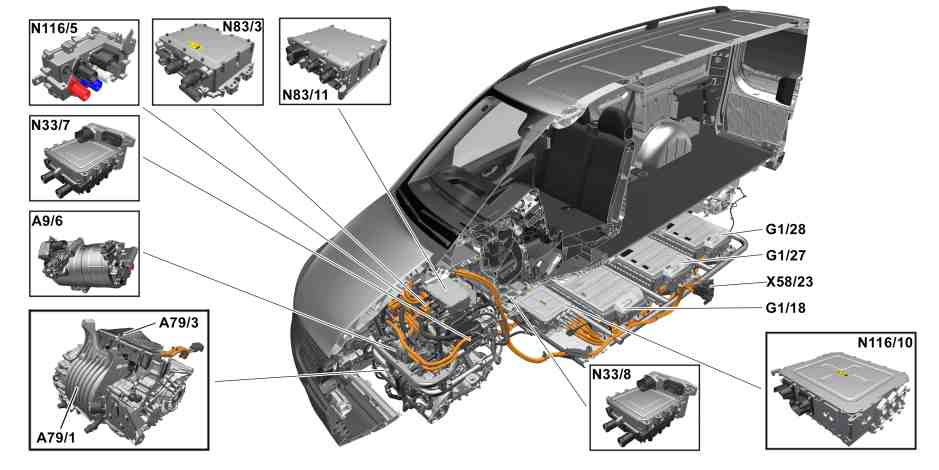
General overview, shown with engine 780.701 |
A9/6 | Electric refrigerant compressor | N33/8 | Battery heater control unit | |
A79/1 | Electric machine | N83/3 | DC/DC converter control unit | |
A79/3 | Electric machine control unit | N83/11 | AC charger for high-voltage battery | |
G1/18 | High-voltage battery 1 | N116/5 | High-voltage distributor module 1 | |
G1/27 | High-voltage battery 2 | N116/10 | High-voltage distributor module 2 | |
G1/28 | High-voltage battery 3 | X58/23 | 230 V feed socket | |
N33/7 | High-voltage PTC heater control unit |
S08.00-A033-79
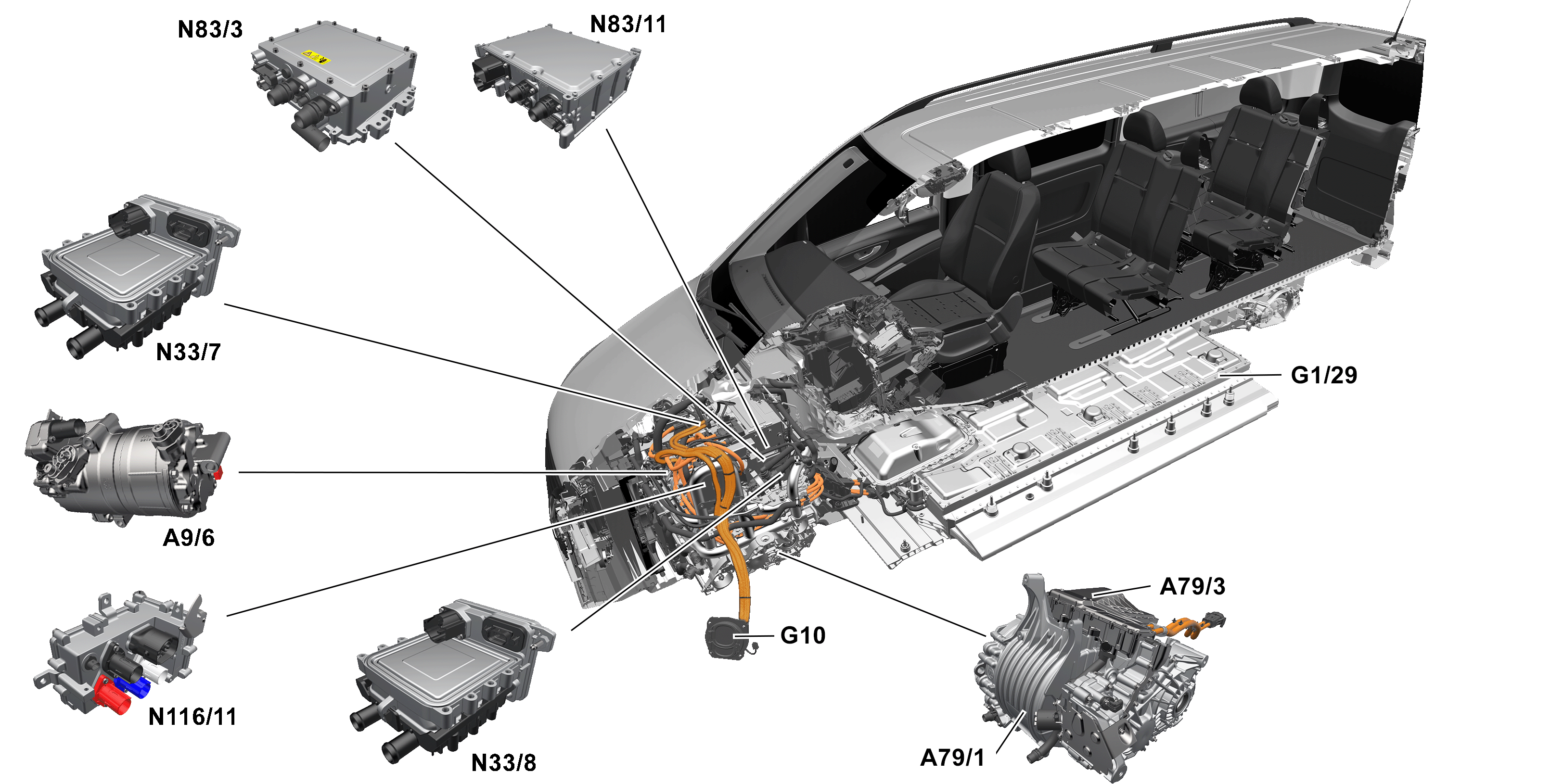
General overview, shown with engine 780.702 |
A9/6 | Electric refrigerant compressor | N33/7 | High-voltage PTC heater control unit | |
A79/1 | Electric machine | N33/8 | Battery heater control unit | |
A79/3 | Power electronics control unit | N83/3 | DC/DC converter control unit | |
G1/29 | High-voltage battery | N83/11 | AC charger for high-voltage battery | |
G10 | DC/AC charging vehicle socket | N116/11 | High-voltage power distributor |
S83.00-A021-79
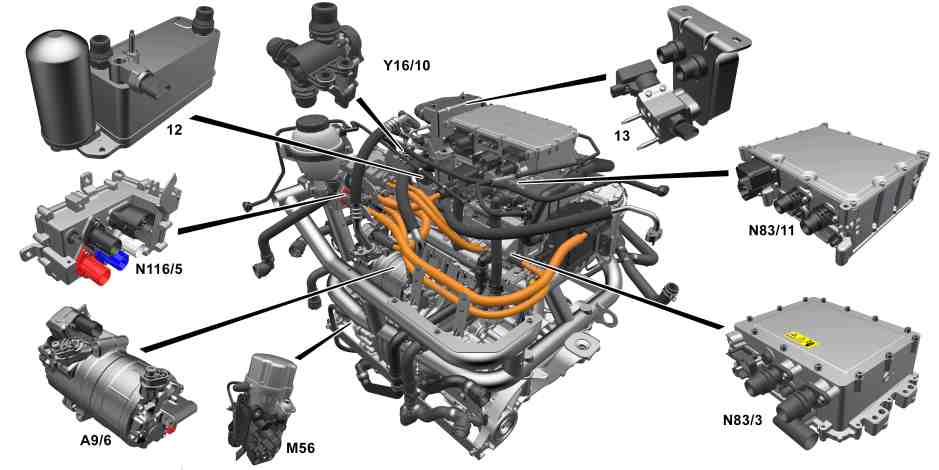
Component part overview, shown with engine 780.701 |
12 | Condenser | N83/3 | DC/DC converter control unit | |
13 | Heat exchanger | N83/11 | AC charger for high-voltage battery | |
A9/6 | Electric refrigerant compressor | N116/5 | High-voltage distributor module 1 | |
M56 | Electric vacuum pump | Y16/10 | Condensation prevention switchover valve |
S83.00-A025-79
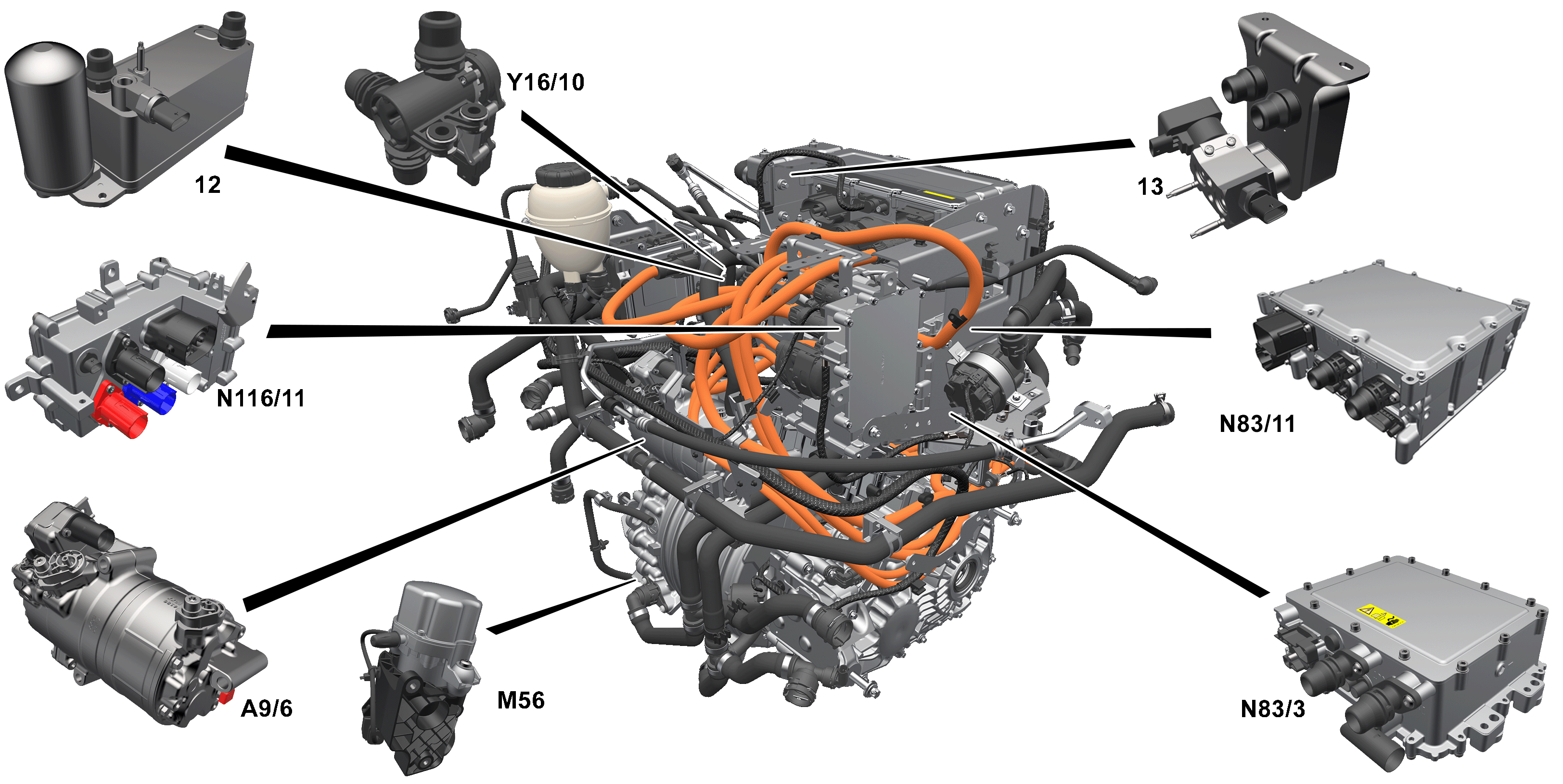
Component part overview, shown with engine 780.702 |
12 | Condenser | N83/3 | DC/DC converter control unit | |
13 | Heat exchanger | N83/11 | AC charger for high-voltage battery | |
A9/6 | Electric refrigerant compressor | N116/11 | High-voltage power distributor | |
M56 | Electric vacuum pump | Y16/10 | Condensation prevention switchover valve |
Danger | Risk of fire/risk of explosion due to short circuit and escaping oxyhydrogen gas. Risk of (burn) injury caused by caustic burns to eyes, skin and mucous membranes from battery electrolyte/mist, short circuit and arcing. Risk of poisoning caused by swallowing battery electrolyte or absorption of lead through the skin or body orifices. Risk of death due to voltage U >= 30 V AC and U >= 60 V DC. | No fires, sparks, open flames, or smoking. Wear acid-resistant gloves, clothing, and glasses. Pour battery acid only into suitable and appropriately marked containers. | |
Danger | Risk of death when working on component parts and systems with U >= 30 V alternating voltage (AC) or U >= 60 V direct voltage (DC) | Do not touch damaged or defective live component parts and lines or non-insulated electrical connections and lines. | |
Topical note | General information on vehicles with high-voltage on-board electrical system and/or lithium-ion battery and/or gaseous-fuel drive system as well as personal protective equipment | ||
Topical note | Notes on battery | ||
| Check | ||
1 | Check whether you have the required qualification for assessing the safety of high-voltage on-board electrical systems. | ||
| Service Information: Qualification measures for working on high-voltage on-board electrical systems, lithium-ion batteries and gaseous fuel drive systems | ||
Checks before entry into the workshop for a vehicle with a fault in the high-voltage on-board electrical system or accident damage | |||
2 | Before entry into the workshop, check the orange high-voltage lines, high voltage components/detachable parts near the high voltage components via a visual check for a fire, smoke development, the consequences of a fire, or internal heat development. | Smoke is often an early indication of fire. | |
If smoke development, tarnishing or scorched component parts are identifiable: | |||
| |||
Immediately make an emergency call using the appropriate location- and country-specific emergency call number; do not touch the high voltage components. Exit the danger zone. | |||
3 | Before entry into the workshop, check whether accident damage to the underbody or in the area of the high voltage components is present. | ||
| Service Information: Handling high-voltage batteries after an accident with airbag and/or pyrofuse triggering | ||
4 | Before entry into the workshop, check lithium-ion batteries for acute hazards. | ||
5 | Bring vehicle into the workshop. | If no problems were determined during operation steps 2 to 4. | |
Additional checks in the workshop for a vehicle with faults in the high-voltage on-board electrical system or accident damage | |||
6 | Connect diagnostic system and run quick test. | ||
| Connect STAR DIAGNOSIS and read out fault memory | ||
If there is a fault message for a high-voltage component or there is an insulation fault, | |||
| |||
rectify these problems as part of the maintenance work in accordance with the repair documentation. | |||
7 | Carry out additional checks of the lithium-ion batteries in the workshop. | If it can be assumed that there is damage because of a fire or accident damage near the lithium-ion batteries or there is a fault message in the diagnostic system. | |
8 | Remove voltage of high-voltage on-board electrical system. | If it can be assumed that orange high-voltage lines or high voltage components are damaged due to a fire or accident damage in the area of high voltage components or a fault message in the diagnostic system. | |
Engine 780.701 in model 447 | |||
Engine 780.702 in model 447 | |||
9 | Check orange high-voltage lines and sockets in the fire area or accident area for damage. | If an orange high-voltage line or existing socket is damaged, | |
| |||
rectify these problems as part of the maintenance work in accordance with the repair documentation. |
Henviste dokumenter
- ad0000s200004e
- ah0000z030001a Generelle oplysninger ved køretøjer med højvoltsnet og/eller litium-ion-batteri og/eller gasdrivsystem samt personligt beskyttelsesudstyr
- ah5410p000101a Oplysninger om batterier
- ah5410p000101a
- ar4770s0017f
- ar4770s1000f
- ar4770s1000g
- as0000z003501a Livsfare ved arbejde på komponenter og systemer med U >= 30 V vekselspænding (AC) eller U >= 60 V jævnspænding (DC)
- as5410z000101a Brand-/eksplosionsfare på grund af kortslutning og udsivende knaldgas. Forbrændingsfare/fare for personskade ved ætsning af øjne, hud og sliminder på grund af batterielektrolyt/-tåge, kortslutning og lysbuepåvirkning. Fare for
- si0000s0156a Serviceinformation: Kvalifikationstiltag i forbindelse med arbejde på bilens højvoltsnet, litium-ion-batterier og gasdrivsystemer
- si5410p0035a Serviceinformation: Håndtering af højspændingsbatterier efter ulykke med udløsning af airbag eller pyrosikring