


285 589 02 21 00
Electric vacuum pump
285 589 01 21 00
NTKL Adaption
285 589 00 21 00
Cooler vacuum filling device
210 589 00 91 00
Test cap

P20.00-2271-09
01a | Coolant reservoir | 01e | Feed valve | 7 | Feed hose | ||
01b | Control unit | 02 | Tester cap | 8 | Waste air hose | ||
01c | Venturi nozzle | 1 | Cooling system cap | 9 | Container | ||
01d | Drain valve | 2 | Coolant expansion reservoir | 10 | Compressed air hose |
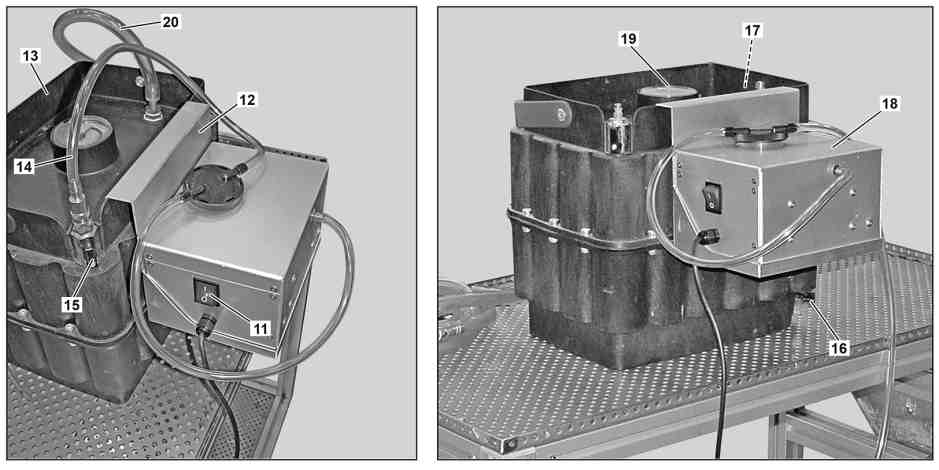
P20.00-2497-09
11 | Switches | 16 | Shutoff valve | |
12 | Bracket | 17 | Shutoff valve | |
13 | NTKL adaptation | 18 | Vacuum pump | |
14 | Hose | 19 | Vacuum indicator | |
15 | Shutoff valve | 20 | Hose |
The special tools vacuum-type cooling system filler, tester cap, NTKL adaptation and electrical vacuum pump are needed.
Only ventilate the engine cooling system for a cold engine.
The drainage container for NTKL adaptation (13) should be emptied after beginning work.
1 | Bring coolant reservoir (01a) to the same height as the coolant expansion reservoir (2). |
2 | Unscrew cooling system closure cap (1) and screw on tester cap (02) at coolant expansion reservoir (2). |
3 | Attach control unit (01b) to tester cap (02) . |
4 | Attach Venturi nozzle (01c) to control unit (01b). |
5 | Close drain valve (01d) and feed valve (01e). |
6 | Place feed hose (7) of the coolant on the coolant reservoir (01a). |
In order to avoid suctioning up of air in coolant reservoir (01a) and for completeness of the filling capacity of the engine cooling system in the vehicle, always completely fill up the coolant reservoir (01a). |
7 | Guide waste air hose (8) into an empty container (9). |
8 | Connect compressed air hose (10) to the Venturi nozzle (01) and apply pressure. |
The overpressure in the compressed air supply must be at least about 8 bar so that sufficient vacuum can be generated through the Venturi nozzle (01c). |
9 | Open drain valve (01d). |
A vacuum is created in the engine cooling system. |
10 | Open feed valve (01e) until feed hose (7) has filled with coolant and subsequently close feed valve (01e) again. |
11 | Close drain valve (01d) if the display on the control unit (01b) is in the green area. |
12 | Remove compressed air hose (10) from the Venturi nozzle (01c) and monitor if the vacuum remains stable for 30 seconds. |
If this is not the case:
Check hoses and connection; repair if necessary and generate a vacuum again.
13 | Close drain valve (01e) and feed valve (01d). |
14 | Bring switch (11) of the electrical vacuum pump (18) into position 0. |
15 | Connect the positive and negative terminal of the electrical vacuum pump (18) using a suitable 12 V voltage source. |
Observe polarity of the positive and negative terminal of the electrical vacuum pump (18). |
16 | Hook bracket (12) into the NTKL adaptation (13). |
17 | Connect hose (14) to the NTKL adaptation (13). |
18 | Close off shutoff valves (15, 16, 17). |
19 | Connect hose (20) to the NTKL adaptation (13). |
20 | Decouple venturi nozzle (01c) and replace by a hose (20). |
21 | Switch in electrical vacuum pump (18) and open shutoff valve (15). |
The vacuum indicator (19) must indicate at least -0.9 bar. |
22 | Open drain valve (01d). |
The feed valve (01e) must remain closed. |
Evacuate the whole engine cooling system for 5 minutes. The indicator for the vacuum indicator (19) must be above the -0.9 bar marking. |
23 | Close drain valve (01d). |
24 | Switch off electrical vacuum pump (18). |
Bring switch (11) of the electrical vacuum pump (18) into position 0. |
25 | Remove hose (14) and display vacuum in NTKL adaptation (13) until the display (19) displays 0.0 bar. |
26 | Check the whole engine cooling system by means of a visual inspection for 30 s for leaktightness. |
27 | Open feed valve (01e). |
The engine cooling system is filled. |
Filling is complete when the control unit (01b) shows 0.0 bar. |
28 | Open drain valve (01d) if coolant is no longer being suctioned. |
29 | Remove control unit (01b) along with all the connections and tester cap (02) . |
30 | Correct coolant level in coolant expansion reservoir (2). |
31 | Screw cooling system cap (1) onto coolant expansion reservoir (2). |