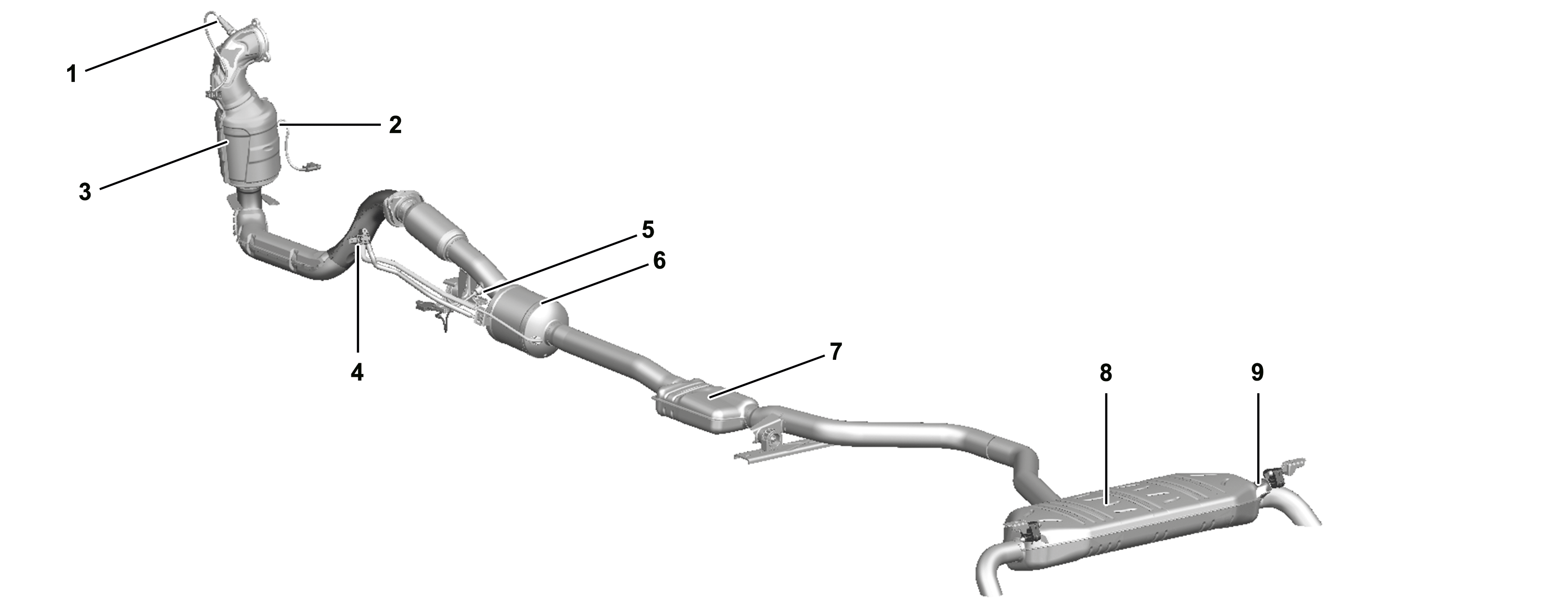
P49.00-A003-78
Display of exhaust system |
1 | Lambda sensor upstream of three-way catalytic converter | 6 | Gasoline particulate filter | |
2 | Lambda sensor downstream of three-way catalytic converter | 7 | Front muffler | |
3 | Three-way catalytic converter | 8 | Rear muffler | |
4 | Gasoline particulate filter differential pressure sensor | 9 | Exhaust flap controller | |
5 | Exhaust system temperature sensor |
Overview
This document contains information on:
General
Function
General
The exhaust system is part of the engine management and fulfills the tasks involved in exhaust gas cleaning:
Exhaust routing away from the vehicle
Cleaning of exhaust gas to reduce pollutants
Recirculating exhaust gas for preventive pollutant reduction
Reduction of exhaust noise
Function
The purpose of the exhaust manifold in the exhaust system is to guide the exhaust gas out of the cylinder exhaust ports and into the exhaust system. The construction affects the engine output, the exhaust gas temperature and the acoustics of the exhaust system. Air gap insulation allows the exhaust manifold to contribute to increasing the exhaust gas temperature, which increases the efficiency of the catalytic converters. The exhaust manifold is produced from heat resistant material to protect against high temperatures, e. g. high-alloyed stainless steel or alloyed cast iron.
Catalytic converters and gasoline particulate filters form the components used for exhaust gas cleaning. They clean and filter the pollutants that are hazardous to health and the environment which are generated during fuel combustion. This includes the following pollutants:
Nitrogen oxides (NOx)
Hydrocarbons (HC)
Carbon monoxide (CO)
Soot particles
Catalytic converters ensure that these pollutants are reduced through the chemical catalytic process. As the pollutants vary depending on the fuel type, different types of catalytic converters are used in diesel and spark-ignition engines. The catalytic converters are installed near the engine. This way, they reach their operating temperature quickly and start working early on, even after a cold start. For the three-way catalytic converter, the operating temperature is, e.g. at 300 °C.
The following catalytic converters are used in exhaust systems, depending on the fuel type:
For diesel engines:
Oxidation catalytic converter
SCR catalytic converter
For spark-ignition engines:
Three-way catalytic converter
A soot particulate filter ensures that the soot particles are filtered and oxidized. It is also installed near the engine. As a result of the higher exhaust gas temperature, the retained soot particles can burn off better during the regeneration phase. Diesel engines rarely reach sufficiently high exhaust gas temperatures to burn off soot particles. For this reason, an oxidation catalytic converter is installed upstream in diesel exhaust systems. It ensures a chemical breakdown of collected soot particles at low exhaust gas temperatures. While the gasoline particulate filter in diesel engines is made of silicon carbide, the gasoline particulate filter in spark-ignition engines is made of Cordierite, which is more heat resistant.
Depending on the fuel, the reduction of emissions is optimized, monitored and regulated by means of appropriate temperature sensors, lambda sensors and NOx sensors. Spark-ignition engines are partially equipped with soot particulate filters without regulating temperature sensors. These soot particulate filters have a high filtration efficiency, are maintenance free and self-regulating. Lambda sensors measure the residual oxygen content in the exhaust gas and are used in spark-ignition engines. NOx sensors determine the nitrogen oxide and oxygen concentration in the exhaust gas as well as the ammonia concentration downstream of the SCR catalytic converters.
Due to its exhaust gas recirculation function, the exhaust system is passively involved in the charge exchange. The design of the exhaust system affects the outflow behavior of the exhaust gas and thus indirectly affects the fresh air supply.
Detailed information | |||
Exhaust system, detailed information | Engine 608 | ||
Components | |||
Exhaust gas flap controller, basic function | Engine all (CAR) | ||
Soot particulate sensor, basic function | Engine 608 | ||
Exhaust system temperature sensor, basic function | Engine 256 in model 167 |