09-6010 Testing turbocharger, determining condition, fault diagnosis
Data KKK-turbocharger Turbocharger T 45
Permissible axial play up to max. 0,16 mm 0,025 to 0,09 mm
Permissible radial play up to max. 0,45 mm
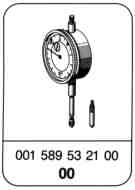

Special tools
Note
An oil pressure loss may cause inadequate lubrication, overheating, loss of performance and destruction of the turbocharger.

Checking axial play
-------------------------------
1 Remove turbocharger (09-6030) or (09-6620).
2 Clamp turbocharger in a vice.
Note
Use protective jaws.
3 Attach dial gauge to the turbine wheel hub.
4 Press down rotor shaft and set dial gauge to "0".
5 Press rotor shaft against dial gauge and read off play.
Dial gauge 001 589 53 21 00
Dial gauge holder 363 589 02 21 00

Checking radial play
-------------------------------
Note
The radial play is determined only at the turbine side.
1 Press turbine wheel to the side, determine the gap between turbine wheel and housing using a feeler gauge, and note.
2 Push turbine wheel in the opposite direction and determine the gap with feeler gauge.
3 The difference between the two values produces the radial play.
Note
Perform measurement at 2 points.
Fault diagnosis
Fault | Cause | Remedy |
Exhaust opacity and drop in performance | Air cleaner severely fouled. Turbine or compressor wheel touching housing. Foreign bodies in exhaust cross-section. Dirty compressor. Leak between exhaust manifold and turbocharger. Exhaust brake flap sticking. Charge air line mis-shapen. Air deficiency Exhaust line downstream of turbocharger or silencer dirty or damaged. Oil separator damaged or fouled. | Clean or replace air cleaner element. Repair or replace turbocharger. Remove foreign bodies. Clean dirt and deposits from compressor. Seal turbocharger to exhaust manifold. Check exhaust brake flap and setting, correct if necessary. Replace charge air line. Check flange and hose connections between turbocharger and charge air pipe for leaks; seal if necessary. Check exhaust line, clean silencer or repair or replace. Replace oil separator. |
Oil level in turbocharger rises, oil flows out through the seal at the turbine and compressor side. | The reduced line cross-section as a result of coking causes an increase in flow resistance in the oil return line. | Clean or replace oil return line. |
Leak in oil feed at turbocharger. | Gasket faulty. | Replace gasket at oil connection. |
Fault | Cause | Remedy |
Whistling noises in area of turbocharger. | Leaks at: - Flanged joints or seals of air and exhaust lines. - Flanged seals (inaccurate shape). - Hose or plug connections. - Rotor rubbing as a result of excessive bearing play. | Replace faulty seals. Check flanged connections for distortion and tight seat. Check whether seals projecting into pipe cross-sections. If this is the case, replace seal. Check that connections are in proper condition and tight. Take off lines and check housing of turbine and compressor side for signs of rubbing. If traces of rubbing exist, exchange turbocharger. |
Oil pressure deficiency | Pressure oil line to turbochager damaged. | Replace pressure oil line |
Oil fouling | Oil filter fouled, incorrect oil filter fitted. | Replace oil filter. Install oil filter as stated in parts documentation. Note - Determine precise diagnosis for oil fouling and rectify. - The turbocharger requires clean oil because of its high speed. - Check whether correct grade of oil has been used (see oil tag or entry in maintenance booklet). - Pour in grade of oil as in Specifications for Service Products, sheet 220. |
Referenced documents
- bb0040p022302a Specified engine oils for Cars, Vans (service) - Overview
- ra00005010002x 0002 - General: Engine model designations Engines OM 441-443 LA, EURO I
- ra00005010004x 0004 - General: Special tools Engines OM 441-443 LA, EURO I
- ra00005010005x 0005 - General: Technical data Engines OM 441-443 LA, EURO I
- ra00005010010x 0010 - General: Tightening torques Engines OM 441-443 LA, EURO I
- ra00005010901x 0901 - Repair of tapped holes using Heli-Coil inserts Engines OM 441-443 LA, EURO I
- ra01005019751x 9751 - Removal, installation and testing of the oil separator Engines OM 441-443 LA, EURO I
- ra09005016030x 6030 - Removal and installation of the turbocharger Engines OM 441-443 LA, EURO I
- ra09005016263x 6263 - Disassembly and assembly of the turbocharger Engines OM 441-443 LA, EURO I
- ra14005015810x 5810 - Checking the exhaust brake setting Engines OM 441-443 LA, EURO I
- ra14005015822x 5822 - Adjustment of the exhaust brake Engines OM 441-443 LA, EURO I
- ra18005013476x 3476 - Removal and installation of the oil filter element Engines OM 441-443 LA - Euro I