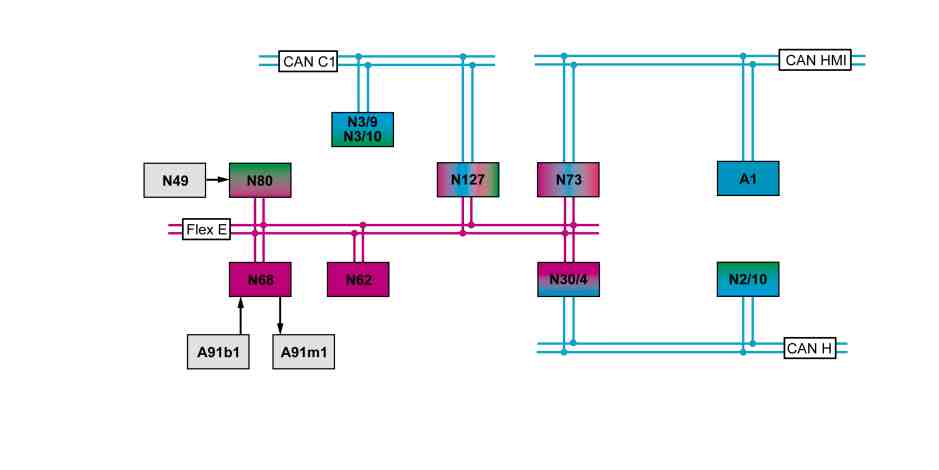
P46.35-2125-79
A1 | Instrument cluster | N68 | Electrical power steering control unit | |
A91b1 | Electric power steering torque sensor | N73 | Electronic ignition switch control unit | |
A91m1 | Electric power steering actuator motor | N80 | Steering column module control unit | |
N2/10 | Supplemental restraint system control unit | N127 | Drivetrain control unit | |
N3/9 | CDI control unit (diesel engine) | CAN C1 | Drive train CAN | |
N3/10 | ME-SFI [ME] control unit (gasoline engine) | CAN H | Vehicle dynamics CAN | |
N30/4 | Electronic Stability Program control unit | CAN HMI | User interface CAN | |
N49 | Steering wheel angle sensor | Flex E | Chassis FlexRay | |
N62 | Parking system control unit (with code 235 (Parking Pilot with PARKTRONIC)) |
Function requirements, general
Terminal 15 ON
Engine running or drive train operational
The electronic ignition lock control unit sends the status of circuit 15 via the chassis FlexRay to the electrical power steering control unit.
The CDI control unit or the ME-SFI control unit sends the "engine running" signal or the "drivetrain operational" signal via the drive train CAN, powertrain control unit and chassis FlexRay to the electrical power steering control unit.
Electric power steering (ES), general
The ES consists of the rack-and-pinion steering gear, the electric power steering torque sensor, the electric power steering actuator motor and the electrical power steering control unit. The ES performs continuously variable, speed-dependent regulation of the power steering.
The ES has the following advantages compared to hydraulic power steering:
Compact design
No hydraulic fluid required
Speed-dependent power assistance
Steering return is assisted
Improved steering feel
Fuel saving
Diagnosis capability
Emergency running
When the ES is switched on, the electrical power steering control unit performs a self-test. If a fault is detected, the ES is not activated. The vehicle can be steered with increased force of the hand.
During driving operation, the electric power steering control unit checks that the electric power steering torque sensor is functioning correctly. If the sensor's signals are below the defined limits, the electrical power steering control unit switches off the ES.
The ES function comprises the following subfunctions:
Power steering
Steer Assist
Power steering
To calculate the required amount of assistance, the electrical power steering control unit evaluates, among other things, the following input factors:
Steering moment
The electric power steering torque sensor records the steering torque applied by the driver. The electrical power steering control unit reads in the signals from the electric power steering torque sensor directly.
Wheel speeds
The Electronic Stability Program control unit sends the wheel speed signals via the chassis FlexRay to the electrical power steering control unit.
Steering wheel angle and steering speed
The steering wheel angle and the steering speed are detected by the steering wheel angle sensor. The steering column tube module control unit reads in the signals from the steering wheel angle sensor directly and sends information about the steering wheel angle and the steering speed via the chassis FlexRay to the electrical power steering control unit.
Engine speed
The CDI control unit or the ME-SFI control unit sends the engine speed via the drive train CAN, powertrain control unit and chassis FlexRay to the electrical power steering control unit.
The electric power steering control unit uses this information to calculate the required electric power steering assistance and actuates the electric power steering actuator motor accordingly. The direction of rotation of the electric power steering actuator motor depends on the direction of movement of the steering wheel. The assistance provided by the electric power steering is transmitted by the electric power steering actuator motor to the rack-and-pinion steering gear.
If an ES assembly part is damaged, the electrical power steering control unit sends the request to output a warning message via the chassis FlexRay, electronic ignition lock control unit and user interface CAN to the instrument cluster. The warning message "Power Steering Defective! Service Required!" is then displayed.
When the engine and ignition are switched off (vehicle standstill), no ES is available. If the engine has been switched off via the ECO start/stop function, reduced assistance is available. When the vehicle is being maneuvered with the engine switched off and the ignition switched on, the electrical power steering control unit activates the ES.
Steer Assist
Steer Assist supports the driver in difficult driving situations. The electrical power steering control unit calculates the amount of assistance required. The Electronic Stability Program control unit assesses the driving situation. The acceleration sensor in the supplemental restraint system control unit assesses the natural dynamics of the vehicle and sends corresponding information (turn rate, lateral acceleration) via the vehicle dynamics CAN to the Electronic Stability Program control unit. In critical driving situations, the Electronic Stability Program control unit sends corresponding requests via the chassis FlexRay to the electrical power steering control unit. The electrical power steering control unit then actuates the electric power steering actuator motor accordingly.
The following functions are performed here:
Driver support through countersteering for a vehicle with oversteer
Driver support for braking on varying road surfaces
The electrical power steering control unit detects when a holding torque needs to be applied by the driver when driving the vehicle straight ahead, e.g. with a crosswind or on a road surface inclined on one side. The required holding torque is partially compensated by the electric power steering.
To rule out incorrect compensation (e.g. highway bend with a large radius), the supplemental restraint system control unit sends information about the natural dynamics of the vehicle via the vehicle dynamics CAN, Electronic Stability Program control unit and chassis FlexRay to the electrical power steering control unit. Reduction of the vehicle's holding torque depends on the speed at which the vehicle is being driven.
Model 238
with code 235 (Parking Pilot with PARKTRONIC)
With automatic parking, the parking system control unit sends corresponding signals via the chassis FlexRay to the electrical power steering control unit.
Referenced documents
- gf4635p9997fh Overview of system components of electric power steering (ES)