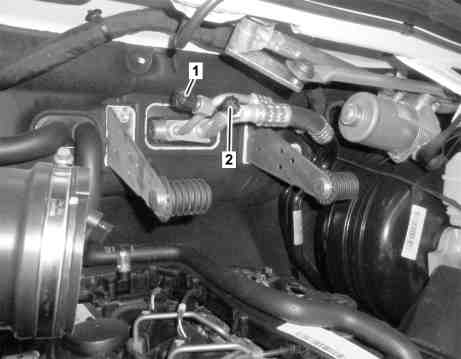
1 | Test and filler connection for high-pressure line |
2 | Test and filler connection for low-pressure line |
D83.30-1267-11
Danger | Risk of fire due to ignition of R1234yf refrigerant on hot components. Risk of poisoning caused by inhaling overheated refrigerant vapors. Risk of injury to skin and eyes caused by contact with escaped R1234yf refrigerant and when working on pressurized parts. Risk of explosion due to formation of ignitable refrigerant/air mixtures | Never perform welding work on or near a closed air conditioning system. No smoking or open flames. Wear safety glasses and protective gloves. Work only in well ventilated rooms. Carry out repair work on the air conditioning system circuit only after the system has been evacuated. | |
Topical note | Procedure for a damaged or leaky air conditioning system | ||
Topical note | Protect air conditioning circuit and components from moisture when carrying out repair work | ||
Notes on handling refrigerant R1234yf | |||
Remove | |||
1 | Remove air filter housing |
| |
Model 906 with engine 642 | |||
Analyze | |||
2 | Unscrew covers from test and filler connection for high-pressure line (1) and test and filler connection for low-pressure line (2) and connect air conditioning service unit | ||
| 000 588 10 82 00 R1234yf air conditioning service unit | ||
When connecting and when operating the air conditioning service unit, the complete work procedure must be conducted in accordance with the operator's manual as issued by the manufacturer. | |||
3 | Analyze refrigerant in air conditioning system | The refrigerant analysis must be performed using an analysis device integrated into the air conditioning service unit or an external analysis device with data transfer to the air conditioning service unit. | |
A positive gas analysis is given when the refrigerant exhibits a degree of purity of min. 98,5 %. | |||
For a positive gas analysis. | |||
| |||
Extract refrigerant from air conditioning system into internal container of air conditioning service unit. | |||
For a negative gas analysis. | |||
| |||
The gas analysis must be performed up to three times. After a third negative gas analysis, the analysis device must be verified in accordance with the operator's manual. | |||
If the analysis device is functional and the gas analysis negative. | |||
| |||
Extract contaminated refrigerant from air conditioning system into a recycling cylinder. | |||
Drain and evacuate | |||
4 | Empty air conditioning system using air conditioning service unit | The volume of compressor oil extracted must be documented. | |
5 | Check desiccant cartridge for re-usability | ||
Topical note | Protect air conditioning circuit and components from moisture when carrying out repair work | ||
If necessary. | |||
| |||
Replace drier cartridge. | |||
| |||
6 | Use the air conditioning service unit to clean the refrigerant and evacuate the refrigerant circuit | ||
7 | Conduct vacuum test using air conditioning service unit | If the air conditioning service unit shows a fault message, then this is an indication that there is a leak in the refrigerant circuit. | |
| |||
Check air conditioning system for leakage. | |||
Fill, check leaktightness | |||
8 | Add new compressor oil to the refrigerant circuit according to the oil filling quantity noted during extraction | ||
| Compressor oils (specification 362.1) | ||
| |||
| |||
| |||
Depending on the repair case, the oil filling quantity may need to be adjusted accordingly. | |||
Total filling capacity of compressor oil in air conditioning system (incl. refrigerant compressor) | |||
Additional oil filling quantity after sudden emptying of system (e.g. line ruptured) | |||
Additional oil filling quantity after replacing condenser | |||
Additional oil filling quantity after replacing evaporator | |||
Additional oil filling quantity after replacement of suction line | |||
Additional oil filling quantity after replacement of pressure line | |||
Additional oil filling quantity after replacement of desiccant cartridge | |||
Additional oil filling quantity with detectable leakage | |||
9 | Fill air conditioning system with air conditioning service unit | ||
| Refrigerant (specification 361.1) | ||
Total filling capacity - refrigerant | |||
10 | Conduct pressure test using air conditioning service unit | In the event of a pressure drop during the pressure test. | |
| |||
Check air conditioning system for leakage. | |||
11 | Disconnect air conditioning service unit, then screw on caps for test and filler connection for high-pressure line (1) and test and filler connection for low-pressure line (2) | ||
| Install | ||
12 | Install air filter housing |
| |
Model 906 with engine 642 | |||
| Check | ||
Warning | Risk of accident from vehicle starting off by itself when engine running. Risk of injury (bruises and burns) resulting from working on the engine while it is being started or when it is running. | Secure vehicle to prevent it from starting off by itself. Wear closed and snug-fitting work clothes. Do not touch hot or rotating parts. | |
13 | Run engine at idle speed for about 4 minutes and check all the component functions which are of relevance for proper operation of the air conditioning system |