
Shown with engine 780.701 |
1 | Heat exchanger |
S20.00-A000-81
S20.00-A001-78
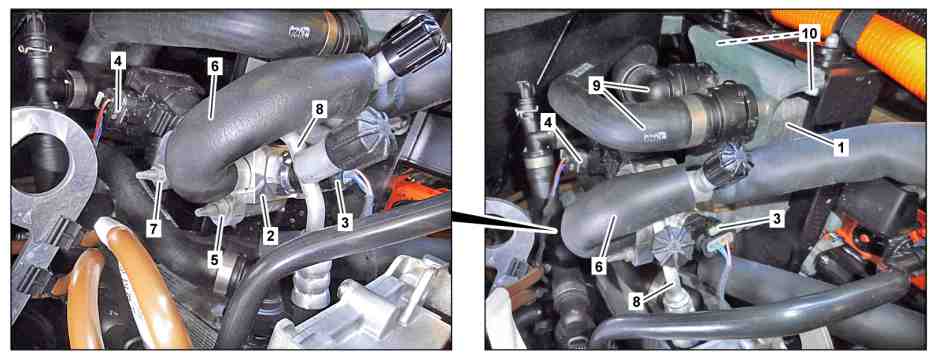
Shown with engine 780.701 |
1 | Heat exchanger | 5 | Nut | 8 | Refrigerant line | ||
2 | Expansion valve | 6 | Refrigerant line | 9 | Coolant hose lines | ||
3 | Electrical connector | 7 | Nut | 10 | Bolts | ||
4 | Electrical connector |
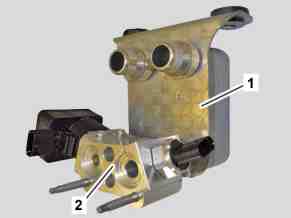
Shown on removed heat exchanger (1) |
1 | Heat exchanger |
2 | Expansion valve |
S20.00-A002-71
Danger | Risk of death when working on component parts and systems with U >= 30 V alternating voltage (AC) or U >= 60 V direct voltage (DC) | Do not touch damaged or defective live component parts and lines or non-insulated electrical connections and lines. | |
Danger | Risk of fire due to ignition of R1234yf refrigerant on hot components. Risk of poisoning caused by inhaling overheated refrigerant vapors. Risk of injury to skin and eyes caused by contact with escaped R1234yf refrigerant and when working on pressurized parts. Risk of explosion due to formation of ignitable refrigerant/air mixtures | Never perform welding work on or near a closed air conditioning system. No smoking or open flames. Wear safety glasses and protective gloves. Work only in well ventilated rooms. Carry out repair work on the air conditioning system circuit only after the system has been evacuated. | |
Warning | Risk of poisoning caused by inhaling overheated refrigerant vapors from an air conditioning system containing R134a. Risk of injury to skin and eyes caused by contact with liquid R134a refrigerant and when working on pressurized parts | Never perform welding work on or near a closed air conditioning system. No smoking or open flames. Wear safety glasses and protective gloves. Work only in well ventilated rooms. Carry out repair work on the air conditioning system circuit only after the system has been evacuated.Engine 780.701 in model 447 | |
Warning | Risk of injury to skin and eyes suffering scalding from contact with hot coolantspray. Risk of poisoning from swallowing coolant. | Do not open cooling system unless coolant temperature is below 90 °C. Open cap slowly and release the pressure. Do not pour coolant into beverage containers. | |
Topical note | General information on vehicles with high-voltage on-board electrical system and/or lithium-ion battery and/or gaseous-fuel drive system as well as personal protective equipment | ||
Topical note | Information on preventing damage to electronic components due to electrostatic discharge | ||
Topical note | Procedure for a damaged or leaky air conditioning system | ||
Topical note | Protect air conditioning circuit and components from moisture when carrying out repair work | ||
Notes on handling refrigerant R1234yf | |||
Notes on handling refrigerant R134a | Engine 780.701 in model 447 | ||
| Remove/install | ||
1 | Drain refrigerant circuit. |
| |
2 | Drain coolant of high-voltage battery cooling system. |
| |
Engine 780.702 in model 447 | |||
3 | Switch off ignition and store transmitter key outside of transmission range (min. 2 m). | ||
4 | Disconnect electrical connectors (3, 4). | ||
5 | Remove nut (5) of refrigerant line (6). | Nut, refrigerant line to expansion valve for high-voltage battery | |
6 | Remove refrigerant line (6) at expansion valve (2). | ||
| Compressor oils (specification 362.1) | ||
Plug openings. | |||
Installation: Install new sealing ring and coat with compressor oil. | |||
Record plug | |||
7 | Remove nut (7) of refrigerant line (8). | Nut, refrigerant line to expansion valve for high-voltage battery | |
8 | Remove refrigerant line (8) at expansion valve (2). | ||
| Compressor oils (specification 362.1) | ||
Plug openings. | |||
Installation: Install new sealing ring and coat with compressor oil. | |||
Record plug | |||
9 | Remove coolant hose lines (9) at heat exchanger (1). | ||
Collect escaping coolant using suitable vessel. | |||
Set of protective covers | |||
10 | Remove screws (10). | Bolt, heat exchanger of high-voltage battery cooling system to holder | |
11 | Remove heat exchanger (1) with attached expansion valve (2) and pressure and temperature sensor. | The heat exchanger (1) is delivered as a replacement part with expansion valve (2) and pressure and temperature sensor. | |
12 | Install in the reverse order. |


001 589 01 91 00
Set of protective covers
129 589 00 91 00
Record plug
Powiązane dokumenty
- ah0000z030001a Ogólne wskazówki dotyczące pojazdów z instalacją wysokiego napięcia i/lub akumulatorem litowo-jonowym i/lub gazowym systemem napędu oraz osobistego wyposażenia ochronnego
- ah5400p000101a Wskazówki dotyczące zapobiegania uszkodzeniom elementów elektronicznych na skutek rozładowania potencjału elektrostatycznego
- ah8330n000301a Wskazówki dotyczące postępowania z czynnikiem chłodzącym R134a
- ah8330n000401a Postępowanie przy uszkodzonym lub nieszczelnym układzie klimatyzacji
- ah8330n000501a Ochrona obwodu i elementów układu klimatyzacji przed wilgocią podczas napraw
- ah8330p000302a Wskazówki dotyczące obchodzenia się z czynnikiem chłodzącym R1234yf
- ar0850s0021f
- ar0850s0022g
- ar0850s8001f
- ar2020p744101rq Otwieranie i zamykanie złącza przewodu płynu chłodzącego
- as0000z003501a Zagrożenie życia podczas prac przy elementach i systemach U >=30 V napięcie zmienne (AC) bądź U >=60 V napięcie zmienne
- as2000z000101a Niebezpieczeństwo zranienia skóry i oczu przez poparzenie wytryskującym, gorącympłynem chłodzącym. Niebezpieczeństwo zatrucia na skutek połknięcia płynu chłodzącego
- as8300z000601a Zagrożenie zatruciem na skutek wdychania przegrzanych oparów czynnika chłodzącego R134a. Niebezpieczeństwo obrażeń w przypadku kontaktu płynnego czynnika chłodzącego R134a ze skórą i oczami oraz podczas obchodzenia się z
- as8300z000701a Zagrożenie pożarem na skutek zapłonu czynnika chłodzącego R1234yf przy kontakcie z gorącymi elementami. Niebezpieczeństwo zatrucia na skutek wdychania przegrzanych oparów czynnika chłodzącego. Niebezpieczeństwo obrażeń w przyp
- bb0040p036201a