Overview
This document contains information on:
General
Function requirements
Function
General
The power take-off on the all-wheel drive is responsible for transferring the torque provided by the dual-clutch transmission to the rear axle.
Function requirements
Drive train operational
Engine in operation
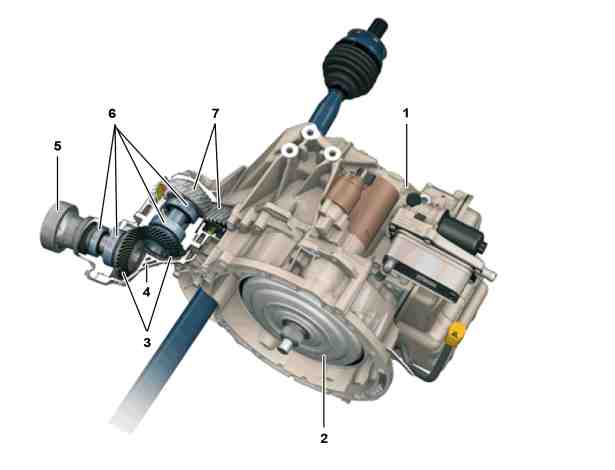
Dual-clutch transmission with power take-off |
1 | Dual clutch transmission |
2 | Dual clutch |
3 | Bevel gears (spirally geared) |
4 | Power take-off |
5 | Propeller shaft flange |
6 | Tapered roller bearing |
7 | Spur gears (helically geared) |
P33.30-2194-76
Function
Power take-off
The propeller shaft is used for torque transfer from the power take-off of the dual-clutch transmission (1) to the rear axle differential.
The transmission-end constant velocity joint of the drive shaft is screwed to the propeller shaft flange (5) of the power take-off (4).
At the rear axle differential, the propeller shaft is screwed to the rear axle differential via a propeller shaft flange (5).
The shafts in the housing of the power take-off (4) are mounted on friction-minimized tapered roller bearings.
Oil supply
The oil supply system ensures that the power take-off component parts are supplied with sufficient oil.
The integrated design means that the power take-off (4) and dual-clutch transmission (1) have a common oil supply and cooling system.
Torque distribution
The regulated drive torque distribution is variable and, by closing the multiplate clutch in the rear axle differential, it routes up to 100 % of the drive torque to the rear axle, depending on the equipment installed. The drive torque is distributed to the front axle and through the power take-off (4) to the rear axle.