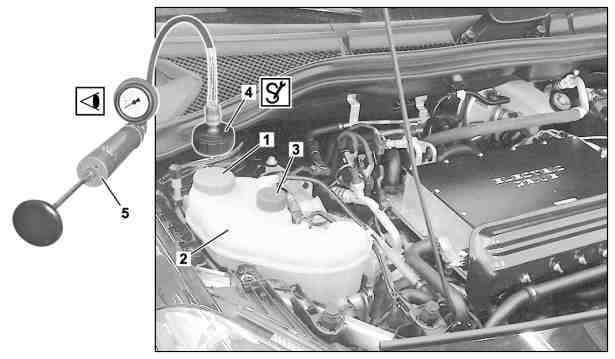
1 | Low-temperature circuit cap |
2 | Coolant expansion reservoir |
3 | Cooling circuit cap |
4 | Tester cap |
5 | Pressure pump |
P20.00-2504-05
Warning | Risk of injury due to fan starting unexpectedly | Do not reach into the rotation or hazard area of the fan. Wear closed and close-fitting work clothes. | |
Warning | Risk of injury to skin and eyes suffering scalding from contact with hot coolantspray. Risk of poisoning from swallowing coolant. | Do not open cooling system unless coolant temperature is below 90 °C. Open cap slowly and release the pressure. Do not pour coolant into beverage containers. | |
Danger | Risk of death when working on component parts and systems with U >= 30 V alternating voltage (AC) or U >= 60 V direct voltage (DC) | Do not touch damaged or defective live component parts and lines or non-insulated electrical connections and lines. | |
Topical note | Information on preventing damage to electronic components due to electrostatic discharge | ||
Topical note | Notes on coolant | ||
| Remove | ||
1 | Unscrew low-temperature circuit cap (1) on coolant expansion reservoir (2) | For working on low-temperature circuit. | |
Open low-temperature circuit cap (1) slowly and relieve overpressure, then unscrew low-temperature circuit cap (1). | |||
2 | Unscrew cooling circuit cap (3) on coolant expansion reservoir (2) | For working on cooling circuit. | |
Open cooling circuit cap (3) slowly and relieve overpressure, then unscrew cooling circuit cap (3). | |||
3 | Check coolant level and antifreeze content of coolant and correct if necessary | ||
Notes on coolant level | |||
If antifreeze content of coolant is too low, either antifreeze protection must be added or the coolant must be replaced. | |||
Coolant mixing ratio | |||
4 | Screw tester cap (4) onto coolant expansion reservoir (2) | For working on low-temperature circuit. | |
Test cap | |||
5 | Screw tester cap (4) onto coolant expansion reservoir (2) | For working on cooling circuit. | |
Test cap | |||
6 | Connect pressure pump (5) to tester cap (4) | Pressure pump | |
7 | Apply a test pressure of a maximum of 1.4 bar to the cooling system | | |
| Check | ||
8 | Perform a visual inspection on the assembly parts carrying coolant | Check condition and coolant loss for all coolant carrying assembly parts and connections. The coolant carrying components should be checked for inner leaktightness if there is no external coolant loss. There is the possibility, for example, that coolant can find its way over a defective cylinder head gasket into the combustion chamber or over a defective water heat exchanger into the oil circuits. | |
Check condition and seating of the Henn coupling. Replace safety spring if necessary to avoid coolant loss. | |||
| Install | ||
9 | Remove test pressure in the cooling system | To do this actuate pressure relief button on the pressure pump (4). | |
10 | Detach pressure pump (5) from tester cap (4) | ||
11 | Unscrew tester cap (4) at coolant expansion reservoir (2) | ||
12 | Check coolant level | ||
Notes on coolant level | |||
13 | Unscrew low-temperature circuit cap (2) on coolant expansion reservoir (1) | For working on low-temperature circuit. | |
14 | Screw cooling circuit cap (3) onto coolant expansion reservoir (2) | For working on cooling circuit. |


169 589 00 91 00
Test cap
210 589 00 91 00
Test cap
124 589 24 21 00
Pressure pump
Henviste dokumenter
- ah2000n208001a Oplysninger om kølervæske
- ah2000p114201cw Oplysninger kølervæskestand
- ah5400p000101a Oplysninger med henblik på at undgå skader på elektroniske komponenter på grund af elektrostatisk afladning
- as0000z003501a Livsfare ved arbejde på komponenter og systemer med U >= 30 V vekselspænding (AC) eller U >= 60 V jævnspænding (DC)
- as2000z000101a Risiko for skoldningsskader på hud og øjne pga. sprøjtende, varm kølervæske. Risiko for forgiftning ved indtagelse af kølervæske
- as2040z000101a Fare for personskade ved utilsigtet start af ventilatoren