D43.40-A040-79
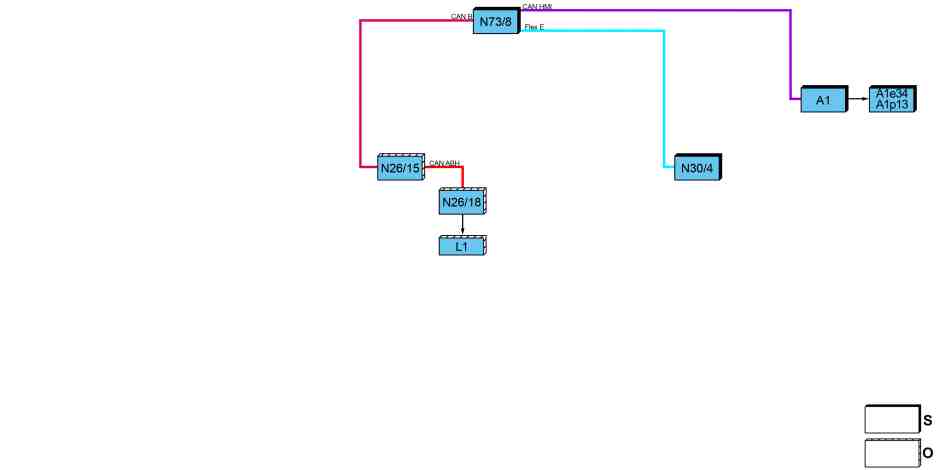
Block diagram of eddy current brake |
A1 | Instrument cluster | N73/8 | Electronic ignition lock (EZS) control unit | |
A1e34 | Retarder indicator lamp | CAN ABH | Body manufacturer CAN | |
A1p13 | Multifunction display | CAN B | Interior CAN | |
L1 | Retarder (eddy current brake) | CAN HMI | User interface CAN | |
N26/15 | Parameterizable special module (PSM) control unit | Flex E | Chassis FlexRay | |
N26/18 | Retarder control unit | O | Optional | |
N30/4 | ESP® control unit | S | Default |
Function requirements
No undervoltage
Status "Tml. 15 ON"
Vehicle speed 3 km/h
Electronic Stability Program ESP® does not regulate.
General
The eddy current brake installed axially in the propeller shaft drive is a wear-free, electromagnetic permanent brake. The brake force (maximum 350 Nm) acts on the rear axle through the propeller shaft thereby relieving the load on the service brake.
The eddy current brake operates contactlessly. Induced eddy currents generate counter-rotating magnetic fields, which then induce a braking effect. The resulting heat is released to the ambient air through radiator fins and cooling vanes.
Function sequence for eddy current brake activation
The retarder control unit is activated by switching on the ignition.
To do so, the electronic ignition lock (EZS) control unit sends the corresponding signal over the parameterizable special module (PSM) control unit to the retarder control unit. This actuates the retarder directly.
Once activated, the retarder control unit runs a self test. Detected faults are indicated by illumination of the retarder indicator lamp or the corresponding symbol in the multifunction display of the instrument cluster.
For this, the retarder control unit sends the corresponding request to the instrument cluster.
Function sequence for eddy current brake actuation
When the brake pedal is applied, both the service brake and the eddy current brake are actuated.
For this, the ESP® control unit sends the corresponding request to the retarder control unit. This actuates the retarder directly.
At a vehicle speed of < 3 km/h or for an ESP® intervention, actuation of the eddy current brake is interrupted.