General test specifications: |
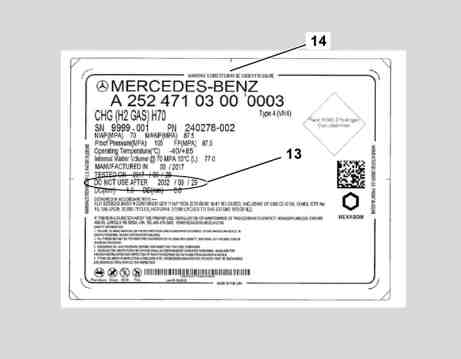
Shown on CHG gas cylinder model plate |
13 | Gas cylinder expiration date |
14 | Gas cylinder model plate |
P47.00-A004-11

Damage to the marking and labeling
The marking and labeling of the gas cylinder shows damage of serial number (1) and damage of matrix code (2). The gas cylinder must only be replaced if all printed serial numbers (1) and matrix codes (2) and/or the gas cylinder expiration date (13) on the gas cylinder model plate (14) is illegible.
Shown on CNG composite gas cylinder type plate |
1 | Serial number |
2 | Matrix code |
P47.10-2865-11
Test specifications for composite gas cylinders: |
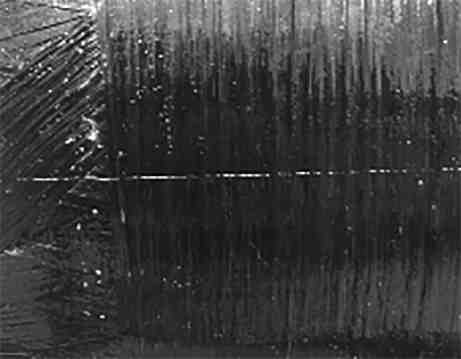
Slight damage due to scratches with a depth of 0.25 mm on composite gas cylinders |
P47.00-A009-11

Severe damage due to cut with a depth of > 0.25 mm on composite gas cylinders |
P47.10-2866-11
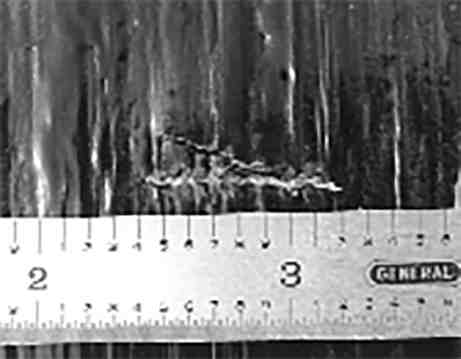
Severe damage due to furrow with a depth of > 0.25 mm on composite gas cylinders |
P47.00-A010-11

Ruptures, fiber cracking and fiber separation due to impact at composite gas cylinder |
P47.00-A013-11
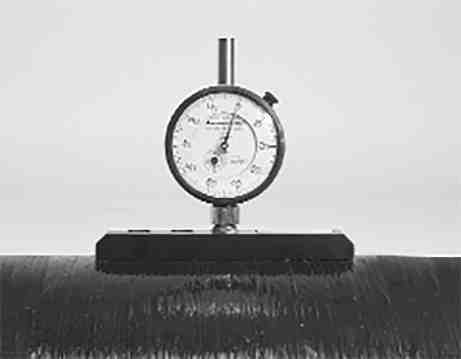
Fibers of composite gas cylinder cut, scratched or furrowed
The gas cylinder exhibits cuts, scratches or furrows.
In the case of slight damage with a depth of 0.25 mm and without damage to the fibers, the gas cylinder can continue to be used.
In the case of slight damage with a depth of 0.25 mm and with damage to the fibers, the gas cylinder must be replaced.
In the case of severe damage with a depth of > 0.25 mm, the gas cylinder must be replaced.
Check the damage depth |
P47.00-A008-11

Protective coating of composite gas cylinders damaged
The protective coating of the gas cylinder exhibits chafe marks. No fibers of the gas cylinder may be damaged; if the fibers are damaged, the gas cylinder must be replaced.
In the case of damage to the protective coating with a depth of > 0.25 mm, the gas cylinder must be replaced.
Chafing mark |
P47.10-2867-11

Composite gas cylinders charred or carbon-fouled
The protective coating of the gas cylinder is blackened or browned in areas. The gas cylinder must not exhibit any permanent charring or carbon fouling; if this is the case, the gas cylinder must be replaced.
Permanent charring |
P47.10-2880-11

Damage to composite gas cylinder due to chemicals, weather conditions or heat
The gas cylinder is permanently damaged due to the influence of chemicals, weather effects or heat. The protective coating and structure of the gas cylinder must not be negatively affected by chemicals, solar radiation, corrosion or heat exposure; if this is the case, the gas cylinder must be replaced.
Damage through heat |
P47.10-2869-11

Damage to composite gas cylinder due to impact
The gas cylinder or the fibers of the gas cylinder must not be permanently deformed or exhibit fiber rips (3) or soft areas; if this is the case, the gas cylinder must be replaced.
Fiber rips due to impact |
3 | Fiber rips |
P47.10-2870-11

Composite gas cylinder damaged by stress corrosion/stress corrosion cracks
The gas cylinder is permanently damaged as a result of stress corrosion/stress corrosion cracks; if this is the case, the gas cylinder must be replaced.
P47.10-2878-11

Slight surface damage on smooth cover caps of composite gas cylinders
The cover cap of the gas cylinders exhibits slight surface damage (without furrows and cracks) that is not larger than 60 x 30 mm; in this case, the cover cap and the gas cylinder can continue to be used.
P47.10-2871-11

Slight surface damage and crack on smooth cover caps of composite gas cylinders
The cover cap of the gas cylinders exhibits slight surface damage that is not larger than 60 x 30 mm and a crack of max. 50 mm in length; in this case, the cover cap must be removed and the gas cylinder checked in accordance with the test instructions to establish whether it is suitable for further use. If the cover cap cannot be removed to check the gas cylinder, the gas cylinder must be replaced.
P47.10-2872-11

Surface damage on corrugated cover caps of composite gas cylinders
The cover cap of the gas cylinders exhibits slight surface damage (without furrows and cracks) that is not larger than two corrugations; in this case, the cover cap and the gas cylinder can continue to be used.
The cap of the gas cylinders exhibits slight surface damage (without furrows and cracks) that extends over three or more corrugations; if this is the case, the gas cylinder must be replaced.
P47.10-2875-12

P47.10-2873-11

P47.10-2874-11

P47.10-2876-11

Severe damage to cover caps of composite gas cylinders
The cover cap of the gas cylinders exhibits severe damage due to large cracks or dents; if this is the case, the gas cylinder must be replaced.
P47.10-2877-10
Test specifications for steel gas cylinders:
Steel gas cylinders must not exhibit any dents/deformation, scratches, corrosion and/or any other damage to the corrosion protection paint; if this is the case, the steel gas cylinder must be replaced.
The condition of steel gas cylinders must be checked no later than every 48 months; this also applies to the section of the cylinders concealed by the tensioning straps.