General information on two-mass flywheels
Two-mass flywheels are formed of two masses that rotate against each other:
First mass at engine end
Second mass at transmission end
The first mass is fastened directly to the engine crankshaft (centering using a dowel pin). The clutch is fastened to the second mass. The torque is transferred between the first mass and second mass by a spring/damper system, known as the torsional damper.
The torsional damper reduces the torsional vibrations of the engine and thus the noises of the drive train. The characteristic of a two-mass flywheel torsional damper is dependent on the engine or its properties and the vehicle. This is why it may be necessary for different two-mass flywheels to be used in different vehicles with the same engine.
Handling two-mass flywheels
Two-mass flywheels that have been dropped may not be installed.
This could lead to damage to the ball bearing or plain bearing, a bent sensor ring or increased imbalance.
Resurfacing the friction surface on the two-mass flywheel is not permissible.
The required burst speed cannot be ensured because the friction surface has been weakened.
In two-mass flywheels with plain bearings, the second mass must not be moved in the axial direction with too much force (e. g. with a lever or screwdriver).
Malfunction or damage can occur otherwise.
Two-mass flywheels must not be cleaned in a parts washing machine or using a high pressure cleaner, steam cleaning, compressed air or cleaning spray.
Malfunction or damage can occur otherwise.
The following points must be observed when installing a two-mass flywheel:
Cleaned clutch friction surface
Position of dowel pin for the clutch
Correct clutch screw lengths
Correct distance from respective crankshaft position sensor
Assessing two-mass flywheels during repair work
When the clutch is disassembled, the second mass friction surface is exposed. The second mass has dowel pins for positioning the clutch. The second mass can be rotated relative to the engine on these dowel pins. This is so that the torsioning play can be measured.
However it is not possible to evaluate the characteristic of the two-mass flywheel by doing so. Special measuring equipment is required for this evaluation, which measures the torque using the angle of torsion as well as the corresponding frictional damping. Measuring equipment like this, however, is not available as special tools.
Possible reasons for exchanging the two-mass flywheel are, e. g.:
Damaged or loose starter ring gear
Conicity of friction surface beyond permissible degree of wear
Engine shaking present at idle speed (after completed diagnosis)
Grease escaping from first mass
Spring fracture
Example images for evaluating whether to reuse or exchange a two-mass flywheel are presented below.

Two-mass flywheel OK
Smaller hot spots on the friction surface.
Two-mass flywheel can be reused.
S03.30-4525-81

S03.30-4527-79
Two-mass flywheel OK
Oil streaks on first mass, at engine end.
Two-mass flywheel can be reused.

Two-mass flywheel OK
Slight thermal overload of second mass (bluish decoloration, bearing is not affected).
Two-mass flywheel can be reused.
S03.30-4526-81

Two-mass flywheel OK
Thermal overload of friction surface or second mass (bluish discoloration). The bluish discoloration on the second mass must not reach the bearing.
If the bluish discoloration is still > 10 mm away from the bearing, the two-mass flywheel can be reused.
S03.30-4535-82

Two-mass flywheel not OK
The bluish discoloration on the second mass has reached the bearing.
Replace two-mass flywheel.
S03.30-4536-82
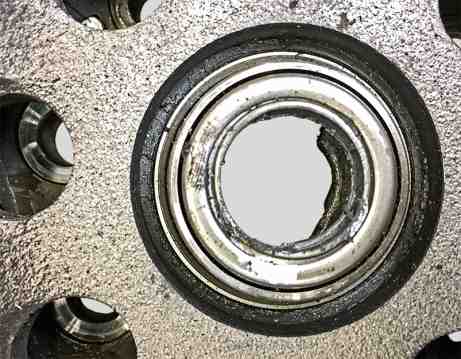
Two-mass flywheel not OK
Bearing of transmission main shaft in two-mass flywheel is defective.
Damage profile emerges when transmission main shaft has been insufficiently centered or if there was an assembly error when installing the transmission.
For this damage profile, the transmission main shaft must also be checked.
Replace two-mass flywheel.
S03.30-4530-81

Two-mass flywheel not OK
Rust formation (reddish discoloration).
Replace two-mass flywheel.
S03.30-4528-81

Two-mass flywheel not OK
Scratches or cracks present on friction surface.
Replace two-mass flywheel.
S03.30-4529-81

Two-mass flywheel not OK
Scoring on the friction surface.
Replace two-mass flywheel.
S03.30-4531-81

Two-mass flywheel not OK
Melted spots on the friction surface.
Replace two-mass flywheel.
S03.30-4533-81

Two-mass flywheel not OK
Oil ingress between first and second mass.
Replace two-mass flywheel.
S03.30-4532-75