20-0004 Coolant circulation and engine cooling
|

A From the thermostat housing to the radiator
B From the radiator to the coolant pump
C Bypass from the thermostat housing to the coolant pump
D Supply to the heater (heat exchanger)
E Return from the heater (heat exchanger)
Coolant circulation engine M 102.945/946
FG 25 157A
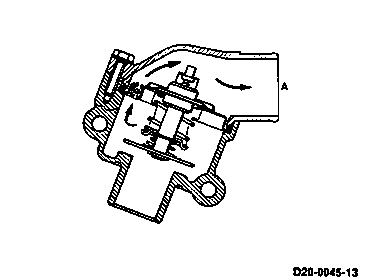
Thermostat
-------------------------------
The thermostat housing with the thermostat
(87 °C) is fastened to the front of the cylinder head.
A to the radiator
D20-0045-13
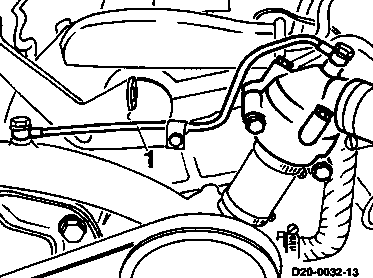
The ventilation pipe between the coolant pump suction side and the thermostat housing lid (1) prevents bubbles forming in the intake duct of the coolant pump, which is located above the thermostat housing.
D20-0032-13
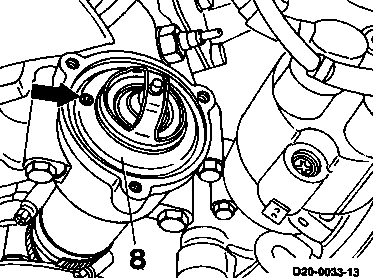
When filling the coolant, the cooling system is automatically ventilated via the ball valve in the thermostat.
The thermostat (8) should be installed with the ball valve uppermost.
D20-0033-13
Engine cooling
-------------------------------
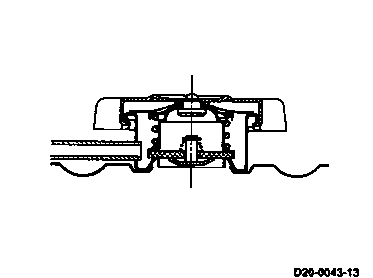
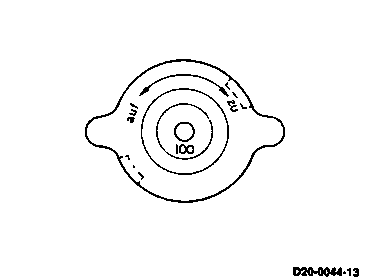
The spring-loaded lid creates an overpressure in the cooling system.
Note
The cooling system is supplied from the factory for the whole year with a coolant composed of 50 % water and 50 % anti-corrosion/anti-freeze agent.
D20-0043-13
The coolant guarantees freeze protection to
-37 °C and additives prevent corrosion in the cooling system. Since the additives are subject to ageing, the coolant should be exchanged every 2 years.
To protect against corrosion the concentration of the anti-corrosion agent should not fall below
40 % volume (-25 °C freeze protection).
Note
Only approved anti-corrosion/anti-freeze agents should be used, otherwise damage to light alloy components may result.
The anti-corrosion/anti-freeze agent in the factory coolant mixture raises the boiling point, which is 118 °C for water at 1 bar pressure, to approx. 135 °C.
The red zone on the coolant temperature indicator begins at 122 °C.
Under full load, mountain, or convoy driving conditions, after fast motorway driving followed by traffic jams, or driving in areas with high outside temperatures the pointer in the coolant temperature indicator may rise into the red zone, given a anti-corrosion/anti-freeze protection of -20 °C, without this being a sign of coolant loss or engine problems.
When vehicles with automatic transmission are stationary for extended periods, e.g. during traffic jams, it is recommended that you put the gear selector into the "N" position. This cuts heat generation by the transmission and reduces the additional heating of the coolant by the transmission oil cooler.
In case of coolant loss due to leakage or boiling over, a suitably prepared coolant should be used to refill the system. A deficiency due to evaporation can be made up with drinking water.
D20-0044-13
Referenced documents
- ra0000m2e0002x 0002 - Installation overview Engine 102 with single belt drive Models 210, 310, 410, 510
- ra0000m2e0003x 0003 - Cross-sections Engine 102 with single belt drive Models 210, 310, 410, 510
- ra0000m2e0004x 0004 - Special tools Engine 102 with single belt drive Models 210, 310, 410, 510
- ra0000m2e0005x 0005 - General engine specifications, performance graphs Engine 102 with single belt drive Models 210, 310, 410, 510