20-1030 Degreasing, descaling cooling system, checking for leaks
- Risk of scalding from hot coolant.
- Do not open the cap of the coolant expansion tank unless the coolant temperature is less than
90 °C.
A. Degreasing, descaling and derusting
Suitable cleaning additives:
Designation | Supplier |
P3 Croni Grisiron 7220 | e.g.: Henkel Düsseldorf e.g.: Farbwerke Hoechst |
Degreasing
1 Drain coolant completely; pay attention to Specifications for Service Products.
2 Remove coolant thermostat (20-2470).
3 Set heater controls to "warm".
4 Fill the cooling system with a 5 % solution of water and a mildly alcaline cleaner, e.g.
P3-Croni (supplier: Henkel) or Grisiron 7220 (supplier: Farbwerke Hoechst) (50 g P3-Croni/
1 liter water).
5 Warm up engine to about 80 °C by running at moderate revs and hold at this temperature for about 5 minutes. The radiator can be covered over, if necessary.
6 Switch off engine and allow to cool down to about 50 °C.
7 Drain solution completely.
8 Immediately after this, fill cooling system twice with fresh water, warm up engine (run about 5 minutes) and drain.
5 Flush cooling system at least 3 times with fresh water; run engine for 5 minutes each time.
6 Install thermostat (20-2470).
7 Fill cooling system with the specified coolant; see Specifications for Service Products, and check for leaks.
Note
- Commercially available products which contain the acids mentioned above may also be used for descaling and derusting.
- Chromic acid or products containing chrome must not be used because of waste water disposal reasons.
Descaling, derusting
Note
The cooling system should always be degreased before performing descaling even if no visible oil contamination is present.
1 After the second flushing operation of degreasing, fill the cooling system with a 10 % (100 g/l) solution of water and citric, tartaric or oxalic acid (available from the chemical trade); citric acid should be used, if possible.
2 Warm up engine to about 80 °C by running at moderate revs and hold this temperature for about 10 minutes.
3 Switch off engine and allow to cool down to about 50 °C.
4 Drain descaling solution completely.
B Checking for leaks
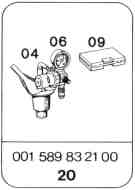
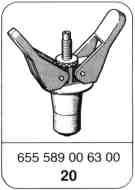
Special tools

1 Unscrew cap of expansion tank.
2 Check coolant level and top up if necessary; see Specifications for Service Products.
3 Clamp adapter (1) tight at the expansion tank.
4 Screw tester (2) tight to the adapter (1).
Tester 001 589 83 21 00
Adapter 665 589 00 63 00
5 Pressurize cooling system to about 1 bar.
Note
A pressure drop is visible at the pressure gauge if there is a leak in the cooling system.
6 Release pressure at the valve (3).
7 Take off tester (2) and adapter (1).
8 Screw cap tight.
Referenced documents
- bb0040p031001a Coolant specifications
- bb0040p031100a Coolant refining agents
- bb0040p031200a Coolant additives (water-soluble) without antifreeze protection requirement
- bb0040p032500a Anticorrosion/antifreeze agents (Sheet 325.0)
- ra00004420002x 0002 - General: Engine model designations EURO II-Engines 445, 446 (OM 441 LA, 442 LA)
- ra00004420004x 0004 - General: Special tools EURO II - Engines OM 441, 442 LA (models 445, 446)
- ra00004420005x 0005 - Technical data EURO II - Engines OM 441, 442 LA (models 445, 446)
- ra00004420010x 0010 - General: Tightening torques EURO II - Engines OM 441, 442 LA (models 445, 446)
- ra20004422470x 2470 - Removal and installation of the coolant thermostats EURO II - Engines OM 441, 442 LA (models 445, 446)