P14.20-2430-79
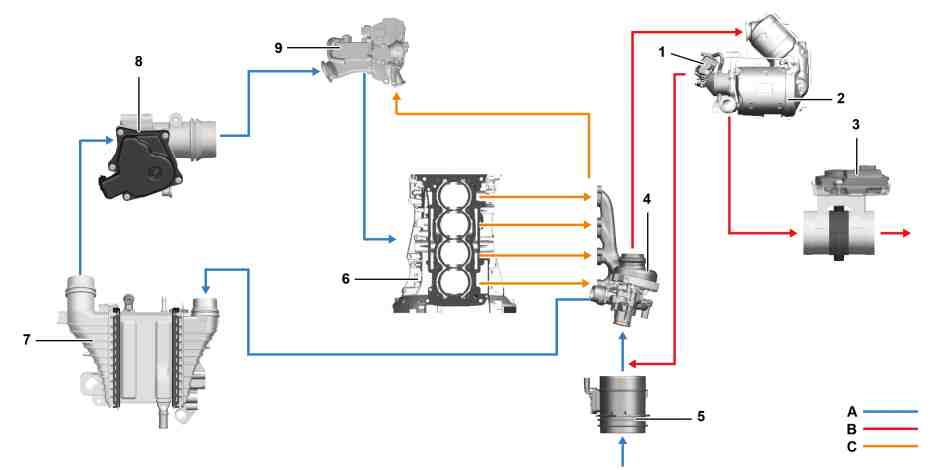
Schematic diagram of outer exhaust gas recirculation |
1 | Low-pressure exhaust gas recirculation valve and exhaust gas recirculation cooler | 5 | Hot film mass air flow sensor | 9 | High-pressure exhaust gas recirculation valve and exhaust gas recirculation cooler | ||
2 | Oxidation catalytic converter, gasoline particulate filter and SCR catalytic converter assembly | 6 | Crankcase | A | Intake air (fresh air) | ||
3 | Exhaust flap controller | 7 | Charge air cooler | B | Exhaust (low pressure) | ||
4 | Turbocharger | 8 | Throttle valve actuator | C | Exhaust (high pressure) |
Overview
This document contains information on:
General
Function requirements
Function
General
Exhaust gas recirculation and exhaust gas cleaning together fulfill the central task of exhaust gas aftertreatment. The exhaust gas recirculation process lowers the nitrogen oxide portion (NOx) in the exhaust gas and reduces consumption. This is done by:
Reducing the oxygen concentration (O2) in the combustion chamber.
Reduction of escaping exhaust flow.
Reducing the combustion temperature through the higher thermal absorption capacity of components such as water (H2O) and carbon dioxide (CO2). They do not participate in the combustion, but influence it.
Function requirements
Engine management ON (circuit 87M)
Coolant temperature approx. 60° C
Engine at idle up to upper partial-load operation, and also in full-load operation in case of high-pressure exhaust gas recirculation
Function
Outer exhaust gas recirculation
Outer exhaust gas recirculation reduces the formation of nitrogen oxide. The core benefit of exhaust gas recirculation is different for diesel and spark-ignition engines. In diesel engines, the main focus of exhaust gas recirculation is on the reduction of nitrogen oxide. Lowering the combustion temperature from 700 °C to 400 °C reduces the production of the majority of nitrogen oxides. In spark-ignition engines, exhaust gas recirculation in partial-load range increases efficiency and reduces consumption. Spark-ignition engines achieve the highest exhaust gas recirculation rates with direct injection with stratified charge operation.
Stratified charge operation means that there is an ignitable rich mixture in the area of the spark plug (lambda = 0.5 – 1.0) while there is excess air in the remaining combustion chamber.
The exhaust gas recirculation system feeds part of the exhaust flow into the fresh air. Depending on the engine speed, the system extracts a defined portion of the exhaust gas, mixes it with the fresh air, and feeds it back into the intake air system. This lowers the exhaust gas temperature and the oxygen content.
The exhaust gas rate defines the portion of recirculated exhaust gas by means of the exhaust gas recirculation valve. The exhaust gas rate differs depending on the operating conditions (output and engine speed), but reaches a maximum value of approx. 40 %. In order to achieve this value, the exhaust gas is cooled before it is recirculated. In addition, high exhaust gas rates, in particular, can be achieved in partial-load operation at medium engine speed. The large amount of excess air present enables a high exhaust gas supply.
The position within the exhaust system at which the exhaust gas recirculation system recirculates the exhaust gas is a crucial factor for the exhaust gas rate. If the system extracts the exhaust gas from the exhaust manifold directly and thus upstream of the exhaust gas turbocharger, we speak of high-pressure exhaust gas recirculation. The exhaust gas returns to the intake air system quickly and at a high temperature.
The high-pressure exhaust gas recirculation enables supply even in full-load operation. The high boost pressure results in a high pressure gradient between the exhaust system and the intake air system, which facilitates the exhaust gas supply.
By contrast, if the exhaust gas is extracted downstream of the exhaust gas turbocharger and the catalytic converter and fed in again upstream of the compressor, we speak of low-pressure exhaust gas recirculation. It is effective in particular with small to medium loads and has the advantage that the exhaust gas temperature is lowered automatically. Due to the long way back to the combustion chamber, there is a homogeneous exhaust gas/air mixture. To increase the effectiveness of exhaust gas recirculation, the system guides the exhaust gas via the exhaust gas recirculation cooler.
In order to achieve optimum efficiency and emission quality in all operating statuses, a combination of both exhaust gas recirculation procedures is often used. Particularly high exhaust gas rates are achieved when the engine is in lean-burn operation.
Exhaust gas recirculation is deactivated during the regeneration phase of the gasoline particulate filter.
Inner exhaust gas recirculation (spark-ignition engine)
The exhaust gas recirculation processes listed are external procedures, i.e. the exhaust gas recirculation takes place via the exhaust system. By contrast, inner exhaust gas recirculation is controlled via a variable valve train. The variable valve train increases the portion of residual gas in the cylinder during the intake phase by leaving the exhaust valve open intermittently. This causes the exhaust gas to be drawn directly into the cylinder. The valve train is regulated by means of camshaft adjustment.
Inner exhaust gas recirculation (diesel engine)
The inner exhaust gas recirculation (diesel engine) additionally has the following function requirements:
Engine in the lower partial-load range up to approx. 1,800 rpm
Engine torque below approx. 100 Nm
The combustion engine control unit actuates the valve lift switchover actuators in the bottom partial-load range. This actuation triggers a second lift of the exhaust camshaft. This second lift causes hot exhaust gases to flow back into the combustion chamber. These uncooled exhaust gases increase the temperature in the combustion chamber, which in turn causes emission control to become effective earlier.
Function schematics | |||
Function schematic of exhaust gas recirculation | Engine 608 in model 118, 177, 247 | ||
Engine 282 in model 118, 177, 247 | |||
Engine 654 in model 118, 167, 177, 247Engine 654 in model 213, 238, 257 as of model year 2021Engine 656 in model 167, 223 | |||
Components | |||
Throttle valve actuator, basic function | Engine all (CAR) | ||
Intake port shutoff, basic function | Engine 654, 656 | ||
Exhaust gas recirculation positioner, basic function | Engine 608, 654, 656 | ||
Exhaust gas recirculation cooler, basic function | Engine 608, 654, 656 | ||
Exhaust pressure sensor, basic function | Engine 654, 656 |