AR49.20-P-2014-02OID | Fill AdBlue(R) tank | ||
Warning | Risk of burn injuries and scalding when working on AdBlue(R) lines and the component parts attached to them. Risk of injury to skin and eyes when handling AdBlue(R). Risk of poisoning caused by swallowing AdBlue(R) | Pour AdBlue® only into suitable containers. Wait until the pressure is released before starting any work on the exhaust aftertreatment system. | |
Notes on use, material properties and handling of AdBlue® | |||
Notes on use, material properties and handling of AdBlue(R) for service |

Example illustration |
P14.40-2628-12
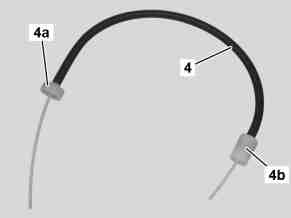
The one-way filling hose (4) is designed so that an unfilled area remains in the AdBlue® tank after the triggering of the locking mechanism.
Once the locking mechanism of the one-way filling hose (4) has triggered, do not fill in any more AdBlue®.
Risk of damage otherwise to AdBlue® tank.
Do not let any foreign objects enter into AdBlue® tank.
The AdBlue® delivery module may be damaged otherwise.
1 | Open AdBlue® refill canister (5) and screw one-way filling hose (4) with canister connection (4a) onto AdBlue® refill canister (5). |
2 | Screw one-way filling hose (4) with filler neck connection (4b) onto AdBlue® tank filler neck (8). |
3 | Lift AdBlue® refill canister (5) as per picture and empty into AdBlue® tank. |
Repeat process if necessary with further containers. In the case of a full AdBlue® tank, AdBlue® is no longer supplied, as the locking mechanism of the one-way filling hose (4) prevents overfilling. |
4 | Lower AdBlue® refill canister (5) to below the level of the AdBlue® tank filler neck (8). |
5 | Carefully unscrew filler neck connection (4b) from AdBlue® tank filler neck (8). |
6 | Lift filler neck connection (4b) above level of AdBlue® refill canister (5) so that AdBlue® can flow back into the AdBlue® refill canister (5). |
P14.40-2568-01