General
For any repair, maintenance, and diagnostic activities on vehicles with a high-voltage on-board electrical system and/or a lithium-ion battery and/or a gas drive system, special qualifications/instructions are generally required in accordance with the given country-specific directives and legislation! Mercedes-Benz/smart specific qualification/instructions for repair, maintenance and diagnostic activities must be observed at all times. Your MPC can inform you about whether further qualifications/instructions are required for any additional country-specific regulations and laws.
For work involving the high-voltage on-board electrical system and/or the lithium-ion battery and/or the gas drive system, the necessary safety precautions must be carried out before starting work. The required safety precautions, e.g. power disconnect of the high-voltage on-board electrical system, and the required personal protective equipment (PPE) are listed in the relevant documentation concerning the topic in WIS, TIPS, EVA, XENTRY Diagnosis. The country-specific specifications must be observed.
Before measuring instruments, tools, aids and personal protective equipment (PPE) are used, they must be checked in accordance with the manufacturer's specifications to ensure that they are in perfect condition.
Personal protective equipment protects against potential hazards when carrying out work, e.g. manual disabling, initial diagnosis of accident vehicles, handling mechanically damaged batteries (removal, evaluation, storage in secure containers).
The following battery types may be affected:
Lead-acid battery with free electrolyte in the following versions:
1 Conventional lead-acid battery with free electrolyte
2 Maintenance free lead-acid battery with free electrolyte
Lithium-ion battery
General information on high-voltage on-board electrical system
The high-voltage on-board electrical system consists of several components. The individual components are directly connected to each other or through electric lines that carry a high voltage.
If the high-voltage contacts (pin and jack) or sealing surfaces of a high-voltage component are separated during the course of a repair procedure, these must be protected against external influences (e.g. dirt, moisture and mechanical loads) in accordance with the relevant documentation on the given topic in WIS, TIPS, EVA, XENTRY Diagnosis. This is especially important if the repair work is not completed immediately and/or the vehicle is parked outdoors.
Defective high voltage lines must always be replaced. The high-voltage line of the high-voltage on-board electrical system must never be repaired or modified.
Modifications that involve an intervention in the high-voltage architecture or a change to high-voltage components and that are not explicitly described and approved by Mercedes-Benz/smart are strictly prohibited.
The vehicle's high-voltage on-board electrical system must not be charged during all service, maintenance, diagnosis and repair operations. The charging cable must be unplugged at the vehicle end. Exception: Charging is permissible, where this is necessary for diagnosis as part of the test procedure, taking qualifications/instructions and protective measures into account.
A risk of injury exists for preprogrammed or remote-controlled pre-entry climate control (PreCon) through the automatic starting up of fans, blowers, pumps in the water circuit or activation of the high voltage PTC heater and the A/C compressor. To suppress the remote functions PreCon and on-board electrical system support during any repair work, they have to be switched off in the instrument cluster or the engine hood/maintenance flap or the trunk lid must be opened, the specific documentation on the topic must be observed.
The disabling and commissioning procedure for the high-voltage on-board electrical system must be documented and affixed to a visible location on the vehicle.
Personal protective equipment (PPE) for activities on high-voltage vehicles or batteries
Potential hazards are:
Electrical hazards due to electric shock, e.g. if contact protection is no longer present
Hazards due to electric arcing in the event of short circuit or when detaching connector couplings
The following list of personal protective equipment (PPE) for high voltage is the minimum requirement specified by Mercedes-Benz/smart. The country-specific specifications must be observed!
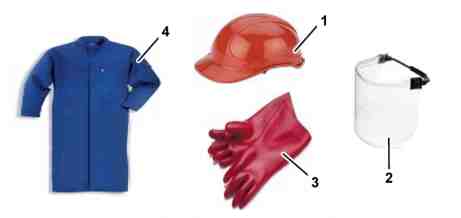
1 | Electrician's helmet without ventilation holes, in accordance with standard EN 397 |
2 | Safety mask/eye protection, in accordance with standard EN 166 |
3 | Protective gloves, in accordance with standard EN 60903.2012 class 0, color red, (marking A (acids), A+H (acid and oil) or R (acid, oil, ozone)) |
4 | Arc flash jacket class 2, in accordance with standard EN/ISO 11612 |
P54.00-A005-80

Identification, color code, protection classes and standards for high voltage protective gloves (3) |
3 | Protective gloves, in accordance with standard EN 60903.2012 class 0, color red, (marking A (acids), A+H (acid and oil) or R (acid, oil, ozone)) |
A | Protection class |
B | DIN standard |
C | Symbol: Suitable for working under applied voltage |
P54.10-4194-80
Before starting work, check when personal protective equipment (PSA) is to be used for the high-voltage on-board electrical system, the relevant documentation on the given topic is available in the WIS, TIPS, EVA, XENTRY Diagnosis and, where applicable, in country-specific specifications.
Removal of released electrolyte
Potential hazards are:
Chemical hazards due to the leakage of liquid media, e.g. electrolyte from a mechanically damaged battery
The personal protective equipment (PPE) listed below which provides protection in the case of battery electrolyte released from lithium-ion batteries is the minimum requirement specified by Mercedes-Benz/smart. The country-specific specifications must be observed!
PSA
Protective gloves (standard EN 60903.2012 class 0 (identification A (acid), A+H (acid + oil) or R (acid + oil + ozone)). In the case of electrolyte in its pure form (no hazard due to high-voltage components): Chemical protection gloves made of nitrile
Tightly fitting safety glasses, goggles or visor
Long-sleeved protective clothing
Respiratory protection (depending on amount of released electrolyte or intensity of release)

5 | Respiratory protection |
6 | Protective gloves |
7 | Safety glasses/goggles/visor |
P00.00-A041-74
Personal protective equipment (PSA) for activities on gaseous-fuel drive systems
Potential hazards are:
Risk of frost/risk of injury
Draining the fuel tank (gas tank) can cause the expanding gas tank to cool down rapidly
Gas-carrying component parts can cool down rapidly
When refueling with pre-cooled gas (cold fill)
If the gas escapes under pressure (e.g. leakage)

8 | Safety goggles |
9 | Protective gloves/assembly gloves |
10 | Winter protective gloves (as an option to the assembly gloves) |
P00.00-A056-74
Information on procurement (PSA)
Personal protective equipment (PPE) in accordance with the country-specific requirements prevalent in the free market as per the specified standards or scope of protection must be made available to the affected employees.
We recommend protective gloves (3) with cotton lining or, for reasons of hygiene, additional cotton glove liners.
MercedesBenz contract partners can order personal protective equipment online from the MercedesBenz Partner Shop at https://partner-shop.mbvd.de.
For company-owned sales and service outlets, the approvals as per the "PPE Catalog" apply.
Before starting work, check when personal protective equipment (PSA) is to be used for lithium-ion batteries to protect against released battery electrolyte, the relevant documentation on the given topic is available in the WIS, TIPS, EVA, XENTRY Diagnosis, and, where applicable, in country-specific specifications.
Check
All tooling, equipment, protection products and aids, which are specified for safe operation and working on, with or in the vicinity of electrical systems, must be suitable for such use, be in proper working condition and be deployed as intended.
Visual inspection of protective gloves before each use for cracks, piercing, abrasion or any other form of damage.
Check protective gloves (3) for leaks before each use by trapping air in the glove (3) and rolling it up, or by using a pneumatic glove tester.
Additional tests as specified by manufacturer.